
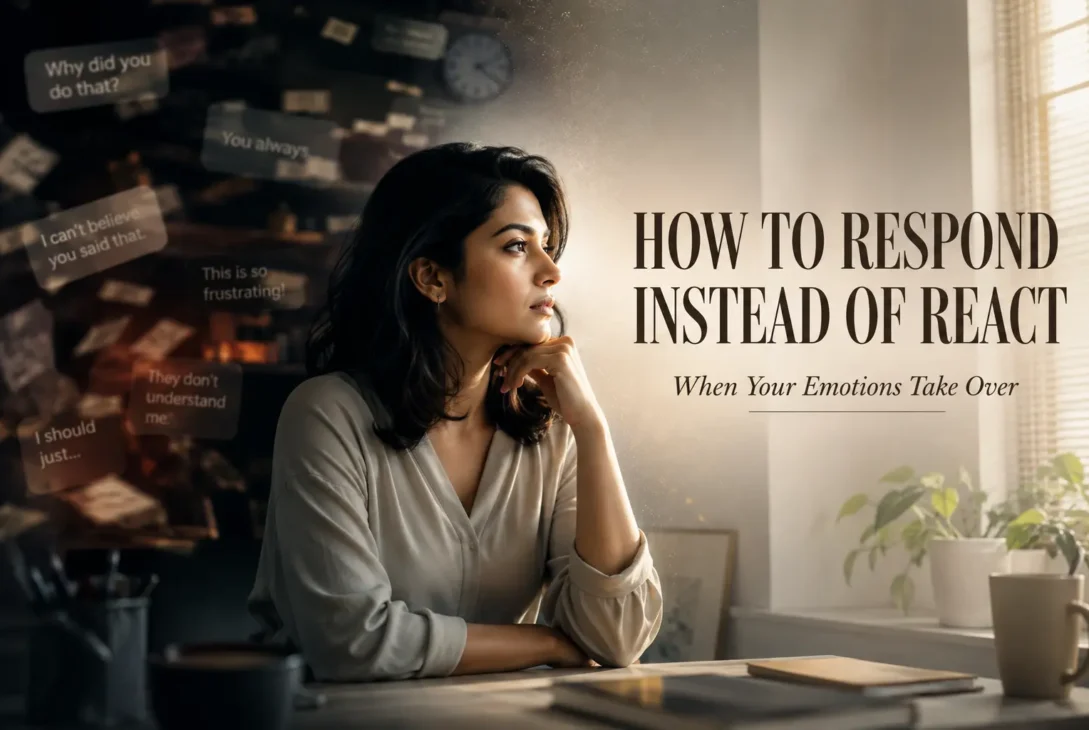
How to Respond Instead of React
Have you ever said something in the heat of the moment and thought about it later?
Maybe someone said something that felt unnecessary, insensitive, or simply wrong to you. You were already tired, irritated, or emotionally overwhelmed—and before you could think, the words came out.
Then, once you were calm, you thought:
“I didn’t really want to say it like that.”
That is the difference between reacting and responding.
Imagine you walk into your boss’s office and say, “I made a mistake.”
A reaction might sound like:
“What? How did this happen? How can you make a mistake like this?”
But a response could be:
“Okay. Tell me what happened. Let’s figure out how we can fix it.”
The situation hasn’t changed. A mistake still happened.
What changed was what happened between the emotion and the response.
And that tiny space can change an entire conversation.
Reacting vs Responding: What’s the Real Difference?

Reacting is usually immediate.
Something happens → you feel something → you act.
There is very little space between the feeling and the action.
Responding is different.
Something happens → you notice what you’re feeling → you pause → you understand the situation → then you choose what to say or do.
But here’s something important: Reacting is not always bad.
We react when someone compliments us. We react with a smile when we see someone we love. We send a ❤️ on WhatsApp because sometimes one emoji says what a whole paragraph cannot.
Reactions can be joyful, loving, spontaneous, and completely natural.
The problem begins when our emotional state starts making decisions for us.
When anger chooses our words.
When hurt chooses our tone.
When insecurity chooses our assumptions.
When exhaustion chooses howwe treat someone.
That’s when learning how to respond instead of react becomes important.
Sometimes, We Don’t React Because We’re Bad People
Sometimes we react because we are already carrying too much.
You wake up tired.
Someone says something that sounds ridiculous.
You have been doing things for everyone.
You have been trying to understand people.
You have been controlling your emotions.
And then one small thing happens.
Suddenly, that small thing doesn’t feel small anymore.
This happened to me recently.
I had a conversation with my Mami in the morning. She said something that, at that particular moment, felt completely unnecessary and unreasonable to me.
I had just woken up, my mood wasn’t great, and I immediately thought:
“Why would you even say something like this?”
Then another thought came in:
“I do so much for you. At least I have the right to expect a little understanding.”
And before I could process any of that, I responded rudely.
I had my reasons.
But reasons don’t automatically make every reaction right.
After the call ended and I became calmer, I thought about it.
Maybe I could have said the same thing without that tone.
Maybe I could have waited.
Maybe I didn’t need to react in that moment.
But then another thought came to me.
“Why am I always the one who has to understand?”
And honestly, that question stayed with me.
Because emotional maturity can sometimes become exhausting when we misunderstand what it means.
It doesn’t mean that you always have to adjust.
It doesn’t mean that you should never expect anything from people.
And it certainly doesn’t mean that every time someone hurts you, you have to become the bigger person while they remain exactly the same.
Sometimes you can take responsibility for your reaction without taking responsibility for someone else’s emotional maturity.
That distinction matters.
10 Ways to Respond Instead of React

1. Notice the Moment Before You Answer
The first step isn’t controlling your emotion.
It’s noticing it.
Before replying, ask yourself:
“What am I feeling right now?”
Angry?
Hurt?
Disrespected?
Embarrassed?
Ignored?
Tired?
Sometimes what looks like anger is actually exhaustion. What looks like irritation is accumulated hurt. And what looks like overreaction is simply the final drop after a very full cup. You don’t have to solve the emotion immediately.
Just notice it.
Because you cannot consciously choose your response if you haven’t even noticed what is driving it.
2. Give Yourself a Pause
A pause doesn’t mean you’re weak. It doesn’t mean you lost the argument and it doesn’t mean the other person was right. Sometimes the most emotionally intelligent sentence is:
“Give me a little time. I don’t want to respond while I’m upset.”
You can take a few breaths, drink some water, walk away for a few minutes, finish the conversation later. The goal isn’t to avoid the conversation.
The goal is to enter it with your mind present.
A five-minute pause can prevent five hours of regret.
3. Ask: “What Exactly Hurt Me?”
Instead of immediately deciding what the other person meant, understand what their words triggered in you.
Was it the actual sentence?
Or did it make you feel unappreciated?
Unimportant?
Disrespected?
Taken for granted?
Sometimes we’re not reacting only to what happened five minutes ago.
We’re reacting to everything that it reminded us of.
Understanding that can completely change the conversation.
4 . Separate the Situation From the Story in Your Head
Someone says:
“You should have done this differently.”
The fact is: they criticized something you did.
The story might become:
“They think I’m useless.”
“They never appreciate me.”
“Nobody understands me.”
“They always do this to me.”
The fact and the story are not necessarily the same thing.
Before responding, come back to what actually happened.
What do I know? What am I assuming?
That one question can stop your mindfrom turning one uncomfortable moment into an entire emotional movie.
5 . Don’t Let Your Tone Say What Your Words Don’t
Sometimes our words sound reasonable, but our tone carries the anger.
“Fine.”
“Okay.”
“Whatever.”
“Do whatever you want.”
Technically, none of these sentences is abusive.
But we know exactly what they can mean when we’re angry.
Responding doesn’t only mean choosing better words.
It means becoming aware of how those words are being delivered.
Because sometimes the problem isn’t what we said.
It’s everything our tone said for us.
6 . Say What You Feel Without Attacking the Person
There is a huge difference between:
“You always make everything about yourself.”
and
“I felt hurt when that happened because I was hoping you’d understand where I was coming from.”
The first attacks the person’s character.
The second explains your experience.
You can be angry without being cruel.
You can disagree without humiliating someone.
You can set a boundary without turning the conversation into a war.
That’s what responding looks like.
7 . Don’t Confuse Understanding With Accepting Everything
This one is important.
Understanding why someone behaved a certain way does not mean you have to approve of it.
You can think:
“Maybe they were stressed.”
and still say:
“But the way you spoke to me wasn’t okay.”
You can understand someone’s circumstances and still protect your own boundaries.
You can forgive someone and still maintain distance.
You can love someone and still disagree with them.
Emotional maturity isn’t unlimited tolerance.
Sometimes responding means calmly saying no.
8. Stop Making Yourself Responsible for Everyone’s Emotional Growth
This is where many emotionally aware people get tired.
You keep thinking:
“Maybe I should explain it better.”
“Maybe I should understand them.”
“Maybe I should communicate more calmly.”
“Maybe I shouldn’t expect so much.”
And yes, working on yourself matters.
But there comes a point where you have to ask:
“Is this relationship asking me to grow—or asking me to carry everything?”
You are allowed to want emotional maturity from the people around you too.
You are allowed to hope that someone will listen.
You are allowed to expect basic respect.
You are allowed to think:
“I understand you. I just wish you would try to understand me too.”
That’s not emotional immaturity.
That’s being human.
9. If You React, Repair It Instead of Defending It
Learning how to respond instead of react doesn’t mean you’ll suddenly become perfectly calm.
You will still have bad days.
You will still lose your patience.
You will still say things you wish you had said differently.
I do too.
The important part is what happens afterward.
Instead of spending hours proving why your reaction was justified, sometimes simply say:
“I was upset, but I shouldn’t have spoken to you that way. I’m sorry for my tone.”
Notice the difference.
You’re not saying:
“My feelings were wrong.”
You’re saying:
“My feelings were real, but I could have handled them better.”
That’s accountability without self-attack.
10 . The Goal Isn’t to Become Emotionless
When you learn how to respond instead of react, the goal isn’t to become someone who never gets angry.
Never gets hurt.
Never gets irritated.
Never says the wrong thing.
That’s impossible.
The goal is much simpler.
When life gives you a moment that triggers you, you want to have enough awareness to say:
“I’m feeling something right now. Let me understand it before I let it decide what I do.”
Maybe you’ll still speak.
Maybe you’ll stay quiet.
Maybe you’ll disagree.
Maybe you’ll set a boundary.
Maybe you’ll apologize.
Maybe you’ll walk away.
But this time, you chose.
And that choice is where emotional maturity begins.
The LUS Reflection
Maybe you are reading this after reacting to someone.
Maybe you’re replaying the conversation in your head and thinking:
“I shouldn’t have said that.”
Before you attack yourself, pause.
Ask yourself:
What was I feeling?
What exactly triggered me?
Was my reaction fair to the situation?
What could I have said differently?
And then ask one more question that we don’t talk about enough:
“Am I taking responsibility for my reaction—or am I taking responsibility for everyone else’s behaviour too?”
Because there is a difference.
You can own your words without carrying someone else’s.
You can improve your response without invalidating your feelings.
And you can become emotionally mature without becoming emotionally unavailable to yourself.

“Emotional intelligence begins when you pause between what you feel and what you choose to do.”
The LUS Takeaway
We often think the opposite of reacting is staying silent.
It isn’t.
The opposite of reacting is choosing.
Choosing to pause.
Choosing to understand.
Choosing to speak instead of explode.
Choosing to set a boundary instead of attack.
Choosing to apologize when you’re wrong.
And sometimes, choosing to admit:
“Yes, I could have responded better—but I also deserved to be understood.”
You don’t have to become perfect to become emotionally intelligent.
You just have to create a little more space between what you feel and what you do with that feeling.
Because emotions deserve to be heard.
But they don’t always need to hold the microphone.