
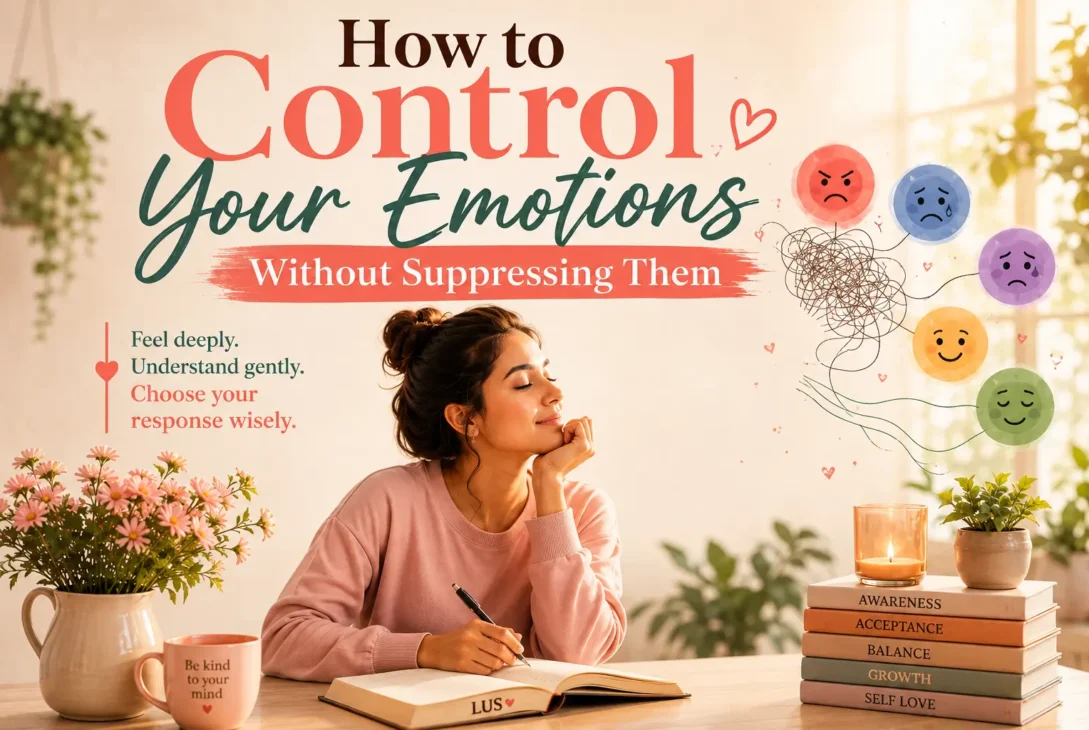
How to Control Your Emotions Without Suppressing Them: Why Most People Get It Wrong
Every person who enters your life leaves behind something—sometimes a beautiful memory, sometimes a painful lesson, and sometimes a wound you don’t even realize you’re carrying.
Each of us is living a different story. We meet different people, face different struggles, and experience life in our own way. Yet despite our different journeys, there is one thing that connects us all—our emotions.
Happiness, anger, disappointment, guilt, fear, love, jealousy, loneliness, hope—emotions are much more than simple feelings. They shape the way we think, influence our decisions, affect our relationships, and slowly define the person we become.
Unfortunately, most of us were never taught how to deal with our emotions. Instead, we grew up hearing phrases like, “Be strong,” “Don’t cry,” “Ignore it,” “Move on,” or “Everything is fine.” Over time, many of us started believing that controlling our emotions means pretending they don’t exist.
However, that’s one of the biggest misunderstandings about emotional strength.
There is a significant difference between controlling your emotions and suppressing them.
When you control your emotions, you acknowledge what you’re feeling, understand why you’re feeling it, and consciously choose how to respond. On the other hand, when you suppress your emotions, you push them deeper inside, hoping they’ll disappear. Unfortunately, they rarely do.
Instead, suppressed emotions behave like pressure building inside a volcano. From the outside, everything looks calm. You continue smiling, working, laughing, and telling everyone that you’re fine. Meanwhile, hidden anger, silent disappointment, unspoken sadness, and unresolved frustration keep building beneath the surface. Eventually, one small incident becomes the final trigger, and everything erupts at once.
This is why people sometimes lose their temper over something that seems insignificant. The real reason isn’t always the situation in front of them—it’s the emotions they ignored for weeks, months, or even years.
Sometimes, the biggest challenge isn’t controlling an emotion. It’s recognizing it.
Have you ever heard someone say, “I don’t know what’s wrong… I just feel strange.” That “strange” feeling could actually be rejection, loneliness, anxiety, guilt, shame, grief, or disappointment. Until we learn to identify what we’re truly feeling, we cannot process it in a healthy way.
I remember a conversation with my uncle that completely changed the way I looked at emotions.
One day, he asked me, “What do you do when you get angry?”
I answered honestly, “Either I cry, or I end up saying things I later regret.”
He smiled and said, “Crying is a sign of weakness.”
I respectfully disagreed.
I told him, “No. Crying isn’t weakness. Giving up on your emotions is. Ignoring what you’re feeling, pretending everything is okay, and never trying to understand your emotions—that’s real weakness.”
That conversation stayed with me because it made me realize something important.
We often judge emotions by how they appear on the outside. Tears are labeled as weakness, while silence is mistaken for strength. But neither tells the full story. A person who cries may be processing their emotions in a healthy way, while someone who never expresses anything might be carrying emotional pain they don’t even understand.
Real emotional strength isn’t about never crying or never feeling angry.
It’s about understanding your emotions before they begin controlling your life.
In this guide, you’ll learn how to control your emotions without suppressing them, understand why emotional awareness is the foundation of emotional intelligence, and discover practical ways to respond thoughtfully instead of reacting impulsively.
Because your emotions are not your enemy—they are messages. The moment you stop suppressing them and start understanding them, you begin taking control of your life instead of letting your emotions control you.
Why We Suppress Our Emotions More Than We Realize
Have you ever wondered why expressing your emotions feels so difficult?
It’s not because you’re emotionally weak.
More often, it’s because somewhere along the way, you learned that being accepted was more important than being honest about how you felt.
From childhood, many of us are taught to be “good.” We learn to be polite, avoid arguments, respect everyone, and keep the peace.These values are important, but as we grow older, life becomes far more complicated than the lessons we learned in school. Real life constantly puts us in situations where we have to choose between protecting our own emotions and protecting other people’s opinions.
Without even realizing it, many of us begin choosing acceptance.
We stay silent because we don’t want to hurt someone.
We pretend everything is fine because we don’t want to look emotional.
We apologize even when we aren’t wrong because we fear losing people.
We keep saying “yes” because saying “no” makes us feel guilty.
Eventually, we become so busy managing everyone else’s emotions that we stop listening to our own.
The truth is, every person is the hero of their own story. However, many of us spend so much time trying to become the hero in someone else’s story that we slowly disappear from our own.
We want everyone to like us.
We want every relationship to work.
We don’t want anyone to misunderstand us.
We try to fit into every room, meet every expectation, and become the version of ourselves that everyone else approves of.
Unfortunately, that constant search for approval comes at a price.
The more we ignore our own feelings to make other people comfortable, the more disconnected we become from ourselves.
I learned this lesson by observing the people around me.
One of my friends rarely admitted what he was feeling. Whenever life became emotionally difficult, he would distract himself with something else, avoid the conversation, or convince himself that nothing was wrong. At first, it looked like emotional strength. However, over time, I realized it wasn’t strength at all—it was avoidance.
Sometimes, ignoring your emotions feels easier than facing them.
But easier doesn’t mean healthier.
The same pattern appears in many of our lives.
Some people are afraid of rejection.
Others fear being judged.
Some grow up believing that crying is weakness, while others believe expressing anger makes them a bad person.
Many people become perfectionists because they think making mistakes will disappoint others.
Meanwhile, people pleasers keep sacrificing their own emotional well-being simply to avoid making someone else uncomfortable.
Although these situations look different, they all have one thing in common—they teach us to suppress our emotions instead of understanding them.
The biggest danger isn’t crying.
The biggest danger isn’t feeling angry.
The biggest danger is reaching a point where you no longer know what you’re actually feeling.
Because once you lose touch with your emotions, you also lose the ability to respond to them in a healthy way.
Emotional suppression doesn’t happen overnight.
It happens one ignored feeling, one forced smile, one fake “I’m okay,” and one people-pleasing decision at a time.
And before you realize it, you’ve become an expert at understanding everyone else’s emotions while forgetting your own.
Recognizing this pattern is the first step toward breaking it.
Because the goal isn’t to become emotionless.
The goal is to become emotionally aware.
What Happens When You Keep Suppressing Your Emotions?
At first, suppressing your emotions doesn’t feel dangerous.
In fact, it often feels like the mature thing to do.
You tell yourself:
“It’s okay.”
“Maybe I’m overreacting.”
“It’s not that big of a deal.”
“I’ll move on.”
And honestly, sometimes ignoring a small emotion does seem harmless.
The problem begins when this becomes your habit.
Imagine this.
You’ve been working hard for months because a promotion is coming. You meet every target, follow every guideline, and genuinely believe you’ve earned it. But when the results are announced, the promotion goes to someone else.
It hurts.
But instead of acknowledging that disappointment, you convince yourself, “Maybe I missed something. It’s okay.”
A few weeks later, you have an argument with a colleague or a friend at work. You feel angry, but you stay silent because you desperately need the job.
Again, you ignore it.
Then another incident happens.
And another.
Every time you swallow your disappointment, your anger, your frustration, or your sadness, you think you’re protecting your peace.
In reality, you’re only postponing the explosion.
Your emotions don’t disappear just because you refuse to express them.
They stay inside you.
Think of it like a volcano.
For a long time, everything looks calm from the outside. People think you’re handling everything perfectly.
But underneath the surface, pressure keeps building.
One day, something very small happens.
Someone says one wrong sentence.
A tiny mistake occurs.
And suddenly, you explode.
Not because of that one moment.
But because of everything you never allowed yourself to feel before.
Now, this doesn’t mean everyone reacts with anger.
Some people become emotionally numb.
Some start crying over small things.
Some develop constant anxiety.
Some lose motivation.
Others begin overthinking every conversation or slowly distance themselves from everyone around them.
Everyone suppresses emotions differently.
But the result is rarely healthy.
Sometimes the damage doesn’t even appear emotionally first—it shows up physically.
Many people carry so much unspoken stress that their body starts paying the price.
Constant headaches.
Poor sleep.
Digestive issues.
Low energy.
Frequent fatigue.
Your mind and body are deeply connected. When your emotions remain trapped for too long, your body often becomes the place where they finally speak.
Suppressing emotions may help you survive today
But if it becomes your lifestyle, sooner or later your emotions will demand attention—through your reactions, your relationships, or even your health.
That’s why emotional intelligence isn’t about hiding your feelings.
It’s about understanding them before they control you.
LUS Reflection
Every ignored emotion leaves a small mark inside us.
One ignored disappointment may not change your life.
But hundreds of ignored emotions slowly become emotional baggage that feels heavier every day.
Healing doesn’t begin when you stop feeling.
It begins when you stop pretending that you don’t.

How to Stop Suppressing Your Emotions in a Healthy Way
The good news is that you don’t have to choose between suppressing your emotions and reacting to everything.
There is a healthier middle path.
Emotional intelligence isn’t about pretending to be calm all the time. It’s about understanding what you’re feeling, expressing it in the right way, and choosing a response that actually helps instead of creating more damage.
Here are a few practices that can help.
1. Accept Your Emotions Instead of Judging Them
The moment you tell yourself,
“I shouldn’t be feeling this way.”
you start suppressing your emotions.
Instead, try saying,
“I’m angry.”
“I’m hurt.”
“I’m disappointed.”
Naming your emotions doesn’t make you weak.
It helps you understand what is actually happening inside you.
You cannot heal emotions that you refuse to acknowledge.
2. Write Everything Without Filtering Yourself
One thing that has helped me the most is writing.
Whenever something deeply upsets me, I don’t try to push those feelings away.
I write.
Not because I’m trying to become a better writer, but because writing clears the noise inside my mind.
Sometimes those pages become conversations with Mahadev and Maa Gauri.
I write exactly what I’m feeling without worrying whether my thoughts sound good or bad.
By the time I finish writing, I don’t always have all the answers.
But I understand myself much better.
Sometimes, that’s all we need.
3. Talk to Someone Who Makes You Feel Safe
Not every conversation needs advice.
Sometimes you simply need someone who will listen without judging you.
When I’m overwhelmed, I often talk to my sister.
I already know she isn’t going to start deciding who’s right and who’s wrong.
She simply lets me empty everything that’s inside me.
This is often called a “word vomit.”
Sometimes your heart just needs space to release everything it has been carrying.
Healing doesn’t always begin with solutions.
Sometimes it begins with finally feeling heard.
4. Let Your Body Release What Your Mind Is Holding
Emotions don’t only stay in your mind.
They stay in your body too.
That’s why whenever I feel intense anger or frustration, I dance.
It may sound simple, but movement helps me release the energy that words cannot.
For someone else, it could be walking, exercising, cooking, painting, gardening, pottery, or anything that brings peace instead of more chaos.
The activity doesn’t matter.
The release does.
5. Don’t React Immediately… Unless the Situation Demands It
People often say,
“Always stay calm.”
It’s good advice.
But real life isn’t always that simple.
Yes, most of the time it’s better to pause before reacting.
Ask yourself,
“Is this person really worth my energy?”
That one question alone can save you from countless unnecessary arguments.
But there are moments when speaking up immediately is the right thing to do.
For example, if someone is being careless with a patient’s health, abusing their authority, or treating people unfairly, staying silent isn’t emotional intelligence.
It’s avoidance.
Even in the Mahabharata, many wise people knew what was wrong but chose silence.
History doesn’t remember that silence as courage.
So don’t suppress your voice when speaking up can protect someone or stop an injustice.
Just make sure you’re responding with clarity, not simply exploding because of emotions you’ve been carrying for months.
6. If You Can’t Talk to Anyone, Don’t Keep It Locked Inside
Not everyone has a trusted friend or family member.
And that’s okay.
But don’t let your emotions stay trapped.
Write them down.
Record a voice note.
Pray.
Create art.
Dance.
Cook.
Do anything that helps you process your emotions instead of burying them deeper.
There is no single right way to heal.
The important thing is that your emotions find a healthy way out.
LUS Reflection
Suppressing your emotions doesn’t make them disappear.
It only delays the moment they ask to be heard.
Your emotions are not your enemies.
They are messages.
Listen to them with kindness, express them with wisdom, and you’ll discover something beautiful:
Healing doesn’t begin when life becomes easier.
It begins the moment you stop running away from what you truly feel.
LUS Reminder:
Emotional intelligence doesn’t mean staying silent.
It means knowing when to stay calm, when to speak up, and when to simply walk away.
Signs You’re Finally Processing Your Emotions in a Healthy Way
Healing doesn’t happen overnight.
There isn’t a day when you suddenly wake up and think, “I’m emotionally healed now.”
It happens quietly.
Through small choices.
Through difficult days.
And through the way you respond to situations that once completely broke you.
I know this because I’ve been there.
For a long time, I believed suppressing my emotions was the easiest option.
I would stay silent, convince myself everything was okay, and keep moving.
But every emotion I ignored eventually came back in a way that hurt me even more.
When I finally started expressing my emotions instead of burying them, something changed.
I felt lighter.
Not because my problems disappeared.
But because I had stopped carrying them alone inside my mind.
That doesn’t mean life suddenly became perfect.
Even today, there are days when I feel frustrated.
There are moments when I want to run away from everything.
For example, one of my biggest goals right now is to stay consistent with my dance classes and build a healthier lifestyle.
But sometimes I fall sick again.
When that happens, I feel angry.
I feel frustrated.
I wonder why my own body keeps stopping me.
Earlier, I would have kept all those emotions inside until they became unbearable.
Now, I write everything in my journal.
I let myself feel the frustration instead of pretending it doesn’t exist.
Once my mind becomes calmer, I stop asking,
“Why is this happening to me?”
Instead, I start asking,
“What can I do next?”
Maybe I need proper rest.
Maybe I need to take my medicines on time.
Maybe I simply need to give my body a few days before returning to dance.
The situation hasn’t changed.
I’m still recovering.
But I’ve realized something important.
I may not be able to control every situation life throws at me, but I can control how I choose to respond to it.
Instead of stretching the frustration, I choose to work on the solution.
Because the more I fight reality, the more exhausted I become.
But the moment I accept what I can’t change and focus on what I can, I move one step closer to becoming stronger.
That, to me, is emotional growth.
Healing doesn’t mean you’ll never feel anger, sadness, or frustration again.
It means those emotions stop controlling every decision you make.
You acknowledge them.
You understand them.
And then you take the next right step.
That’s how you slowly become emotionally stronger.
Not by avoiding difficult emotions…
But by learning how to walk through them.
LUS Reflection
Life will always give you reasons to feel disappointed.
The real question is:
Will you let those emotions become a prison, or will you let them become a teacher?
You don’t have to win every battle.
You don’t have to feel positive every single day.
You just have to refuse to give up on yourself.
Because the goal isn’t to never fall.
The goal is to keep getting back up, no matter how many times life knocks you down.
And maybe that’s what emotional intelligence truly is.
Not controlling your emotions…
But learning how to live with them, understand them, and still keep moving forward.
Your emotions are not your weakness.
Ignoring them is.
Listen to them, learn from them, and let them guide you—not control you.
Because healing doesn’t begin when life becomes easier.
It begins the moment you stop running away from what you truly feel.

Conclusion – Your Emotions Are Not the Enemy
Throughout my own journey, I’ve realized something that I wish I had understood much earlier.
Even today, small things can hurt me deeply, while sometimes I laugh off situations that seem much bigger. The difference is that now, I understand what my emotions are trying to tell me.
I know they’re connected to both my mental and physical health.
That’s why I no longer ignore them, neglect them, or constantly distract myself from them.
Instead, I try to understand them.
Of course, there are situations that are beyond my control.
And yes, sometimes I choose to distract myself for a while—not because I’m running away, but because I know I can’t solve everything immediately.
There’s a difference between taking a healthy pause and emotionally escaping from reality.
From my experience, the more I suppressed my emotions, the more problems I created for myself.
The moment I started listening to them instead of fighting them, I slowly started understanding myself better.
Life is already simple.
We are often the ones who make it complicated by ignoring what our heart and mind are trying to tell us.
Your emotions are not your enemy.
Sometimes, they are simply asking you to pay attention to yourself.
LUS Takeaway
Life is temporary.
So why spend it pretending you’re okay when you’re not?
Feel your emotions.
Understand them.
Take care of your mind as much as you take care of your body.
And whenever life throws you into a situation you can change, work on the solution.
If you can’t change it, learn to accept it.
If acceptance isn’t possible yet, take a step back, give yourself time, and don’t force yourself to have all the answers today.
And if there comes a moment when you genuinely can’t see a way forward…
Leave it to Mahadev.
That’s what I chose to do.
And honestly…
Everything eventually finds its place.
You don’t have to be emotionally perfect.
You just have to stop abandoning yourself every time life becomes difficult.
Because healing begins the day you stop suppressing your emotions… and start listening to them with honesty, kindness, and courage.
If there’s a problem, look for a solution.
If you can’t solve it today, learn to accept it.
And if acceptance still feels difficult, give yourself time instead of giving up on yourself.