Chhath Puja
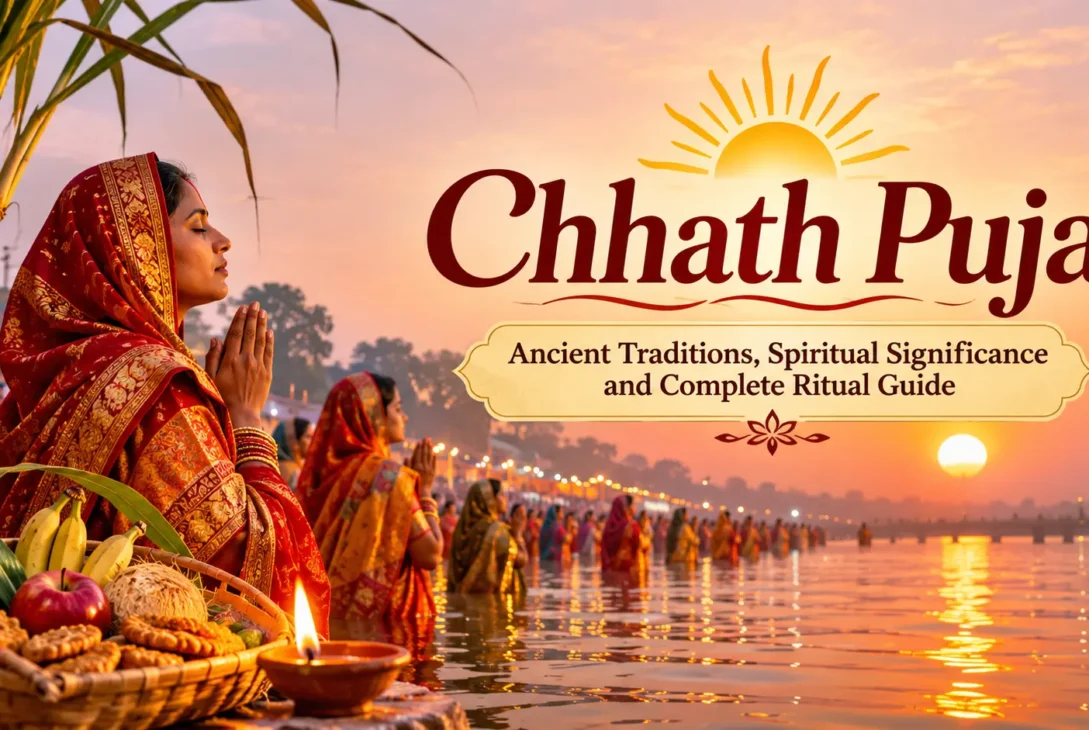
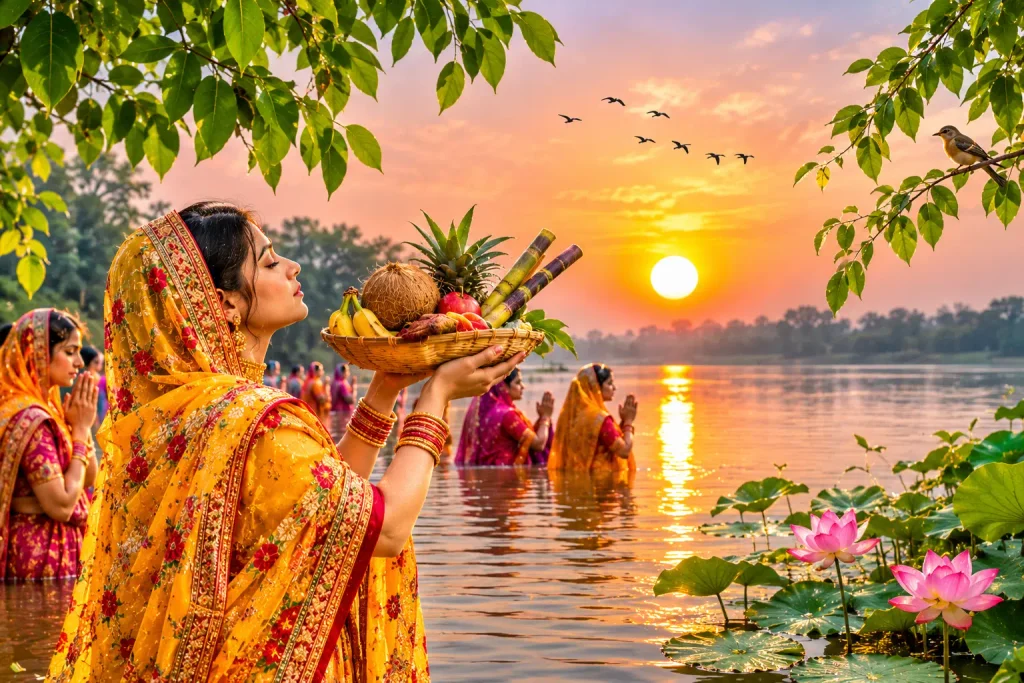
Every year, as the festival season moves beyond Diwali, riverbanks and ponds across Bihar, Jharkhand and eastern Uttar Pradesh begin to transform into places of devotion. Families gather to prepare traditional offerings, bamboo baskets are filled with fruits and sweets, devotional folk songs fill the air, and devotees stand in water with folded hands, offering prayers to the setting and rising Sun.
This is Chhath Puja, one of the most distinctive and spiritually significant Hindu festivals of India.
Dedicated primarily to Surya Dev, the Sun God, and accompanied by the worship of Chhathi Maiya, Chhath Puja is a celebration of gratitude, purity, discipline and the natural forces that sustain life. Unlike many festivals centred around elaborate temple ceremonies, its most important rituals take place in the presence of nature, particularly near rivers, ponds and other water bodies.
Observed over four days, the festival involves ritual bathing, preparation of traditional food, fasting, prayers and offerings to the Sun at sunset and sunrise. Every practice carries cultural and spiritual meaning, reflecting a deep connection between human life, nature and the divine.
However, Chhath Puja is much more than a religious observance. It represents an enduring cultural heritage, a collective expression of faith and a reminder that the resources sustaining human existence deserve gratitude and respect.
In this guide, we explore the history, mythology, spiritual significance, traditional offerings and complete rituals of Chhath Puja, helping readers understand not only how the festival is celebrated but also why its traditions continue to hold such importance.
✦ What Is Chhath Puja?
Chhath Puja is an ancient Hindu festival dedicated to the worship of Surya Dev, the Sun God, and Chhathi Maiya, who is associated with Goddess Shashthi in popular religious traditions. It is celebrated with particular devotion in Bihar, Jharkhand, eastern Uttar Pradesh and parts of Nepal. Over time, the festival has also become an important cultural celebration among communities living in different parts of India and abroad.
The word Chhath is commonly associated with the sixth day of the lunar fortnight, known as Shashthi. The principal Kartik Chhath observance takes place on the sixth day of the bright fortnight of the Hindu month of Kartik, shortly after Diwali.
The festival is also known by several names, including Surya Shashthi, Dala Chhath and Chhath Mahaparv.
One of the most distinctive features of Chhath Puja is that devotees offer prayers to both the setting Sun and the rising Sun. This makes the festival particularly remarkable because it recognises the importance of the Sun throughout its daily journey, rather than celebrating only the beginning of a new day.
Although women are traditionally prominent among those observing the rigorous fast, men also participate as devotees. Entire families and communities contribute to the preparations, making Chhath a collective celebration of faith.
Chhath Puja is also observed twice a year in many traditions: Kartik Chhath during October–November and Chaiti Chhath during March–April. Kartik Chhath is generally the more widely celebrated observance.
✦Who Is Chhathi Maiya and Why Is She Worshipped?
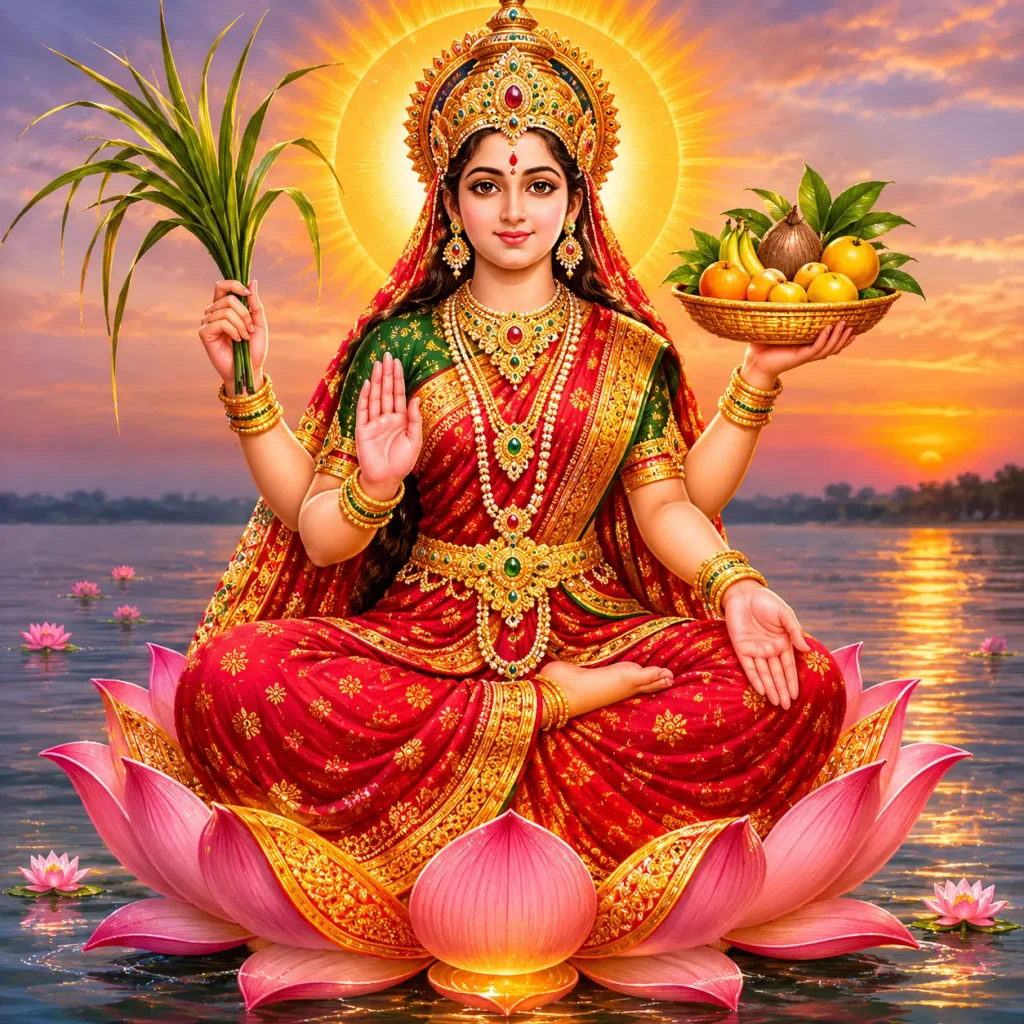
According to Puranic traditions, Goddess Shashthi is described as the daughter of Lord Brahma and the wife of Lord Kartikeya, who is also known as Devasena. She is revered as a divine protector associated with childbirth, motherhood, fertility and the well-being of children. In the popular folk traditions of Bihar, Jharkhand and eastern Uttar Pradesh, Chhathi Maiya is also lovingly regarded as the sister of Surya Dev. This regional belief explains why both Surya Dev and Chhathi Maiya hold an important place in Chhath Puja. While Surya Dev represents the life-sustaining energy of the universe, Chhathi Maiya is worshipped for the protection of children, family happiness and the well-being of future generations. These different mythological and regional associations reflect the rich devotional traditions surrounding the festival.
In many regional beliefs, she is regarded as a guardian of children and families. Devotees pray to her for the health of their children, protection from difficulties and happiness within the household.Some traditions also associate Chhathi Maiya with the divine powers of nature and the broader solar family. Interpretations of her identity may vary across communities and religious traditions. Her worship during Chhath Puja reflects the importance of family welfare and the continuity of generations.
For many families, the festival is an opportunity to express gratitude for their children and seek blessings for their future.It is also important to understand that Chhathi Maiya’s worship is not separate from the central solar devotion of Chhath. Both are woven together in the festival’s spiritual traditions.
✦ History and Ancient Origins of Chhath Puja
Understanding the origins of Chhath Puja requires looking at India’s ancient traditions of nature worship, particularly the reverence for the Sun.
Long before modern scientific understanding of solar energy, human communities recognised the Sun as essential to everyday existence. Its light supported agriculture, influenced seasons, provided warmth and made life possible on Earth. Naturally, the Sun became an important object of reverence in many ancient civilisations, including the Indian subcontinent.
In ancient Hindu religious traditions, Surya holds an important position as a divine representation of light, vitality, energy and life. The Rig Veda contains several hymns dedicated to Surya and other solar deities, reflecting the importance of sunlight in Vedic religious thought.
Chhath Puja continues this tradition of reverence through its distinctive rituals. Devotees express gratitude to Surya Dev for sustaining life, supporting agriculture and providing the natural energy required by living beings.
However, it is important to distinguish between the ancient history of Surya worship and the precise historical origin of the present-day Chhath festival. Although its practices are rooted in longstanding Hindu traditions, there is no single universally established historical account that identifies the exact beginning of Chhath Puja in its current form.
The festival is especially associated with the cultural heritage of Bihar and the wider Gangetic region. Its traditions have been preserved through generations, particularly through family practices, folk songs, seasonal food preparations and community participation.
The importance of Chhath has also travelled beyond its traditional geographical regions. Migration has helped carry the festival to cities across India and to international communities, where families continue to observe the rituals to maintain their cultural connection.
Thus, Chhath Puja represents both an ancient reverence for nature and a living cultural tradition that continues to evolve while preserving its essential spiritual character.
✦ The Spiritual Meaning and Significance of Chhath Puja
At its heart, Chhath Puja is an expression of gratitude towards the natural forces that make life possible.
The Sun provides light, warmth and energy. Water sustains living beings, supports agriculture and maintains ecological balance. The festival brings these two essential elements together through rituals performed near water bodies under the open sky.
◆ Worship of Surya Dev: The Source of Life
In Hindu tradition, Surya Dev is regarded as a powerful symbol of energy, health, vitality and consciousness. The Sun’s presence influences the natural cycles of the Earth, including daylight, seasons and agricultural growth. Its energy is essential for photosynthesis, which supports the food chain and sustains life.
Through Chhath Puja, devotees express gratitude to Surya Dev for this life-giving energy. They pray for good health, prosperity, longevity and the well-being of their families.The worship is not simply an appeal for personal blessings. It also reflects an acknowledgement of humanity’s dependence on nature.
◆ Why Are Both the Setting and Rising Sun Worshipped?
One of the most meaningful aspects of Chhath Puja is the offering of Arghya at two different times: sunset and sunrise. During Sandhya Arghya, devotees worship the setting Sun. During Usha Arghya, they welcome the rising Sun with prayers and offerings.
The evening offering recognises the Sun’s journey through the day and expresses gratitude for the energy and nourishment received. The morning offering represents renewal, hope and the continuation of life.Together, these rituals can also be understood as a reminder that every phase of life deserves acknowledgement. The setting Sun is not treated as less worthy of reverence than the rising Sun.
This symbolism offers a meaningful reflection on acceptance, gratitude and the natural cycles of existence.
◆ The Significance of Chhathi Maiya
Alongside Surya Dev, devotees worship Chhathi Maiya, popularly associated with Goddess Shashthi. In Hindu religious traditions, Shashthi Devi is connected with the protection and well-being of children, motherhood, fertility and family welfare.
Devotees seek her blessings for the health of children, happiness in family life and the well-being of future generations. The presence of Chhathi Maiya in the festival adds another dimension to its spiritual meaning. While Surya Dev represents the life-sustaining energy of the universe, Chhathi Maiya is associated with nurturing, protection and the continuity of life.
◆ Purity, Discipline and Self-Control
Chhath Puja is also known for its strict observance of cleanliness, dietary discipline and fasting.
Devotees prepare for the festival by cleaning their homes, maintaining purity in food preparation and following prescribed rituals. The person observing the fast, commonly called the vrati or parvaitin, undertakes the observance with dedication and self-discipline.
These practices are traditionally understood as ways of preparing the body and mind for prayer. The deeper message is that devotion involves more than asking for blessings. It also requires sincerity, patience, discipline and a sense of responsibility.
✦ Mythological Stories Associated with Chhath Puja
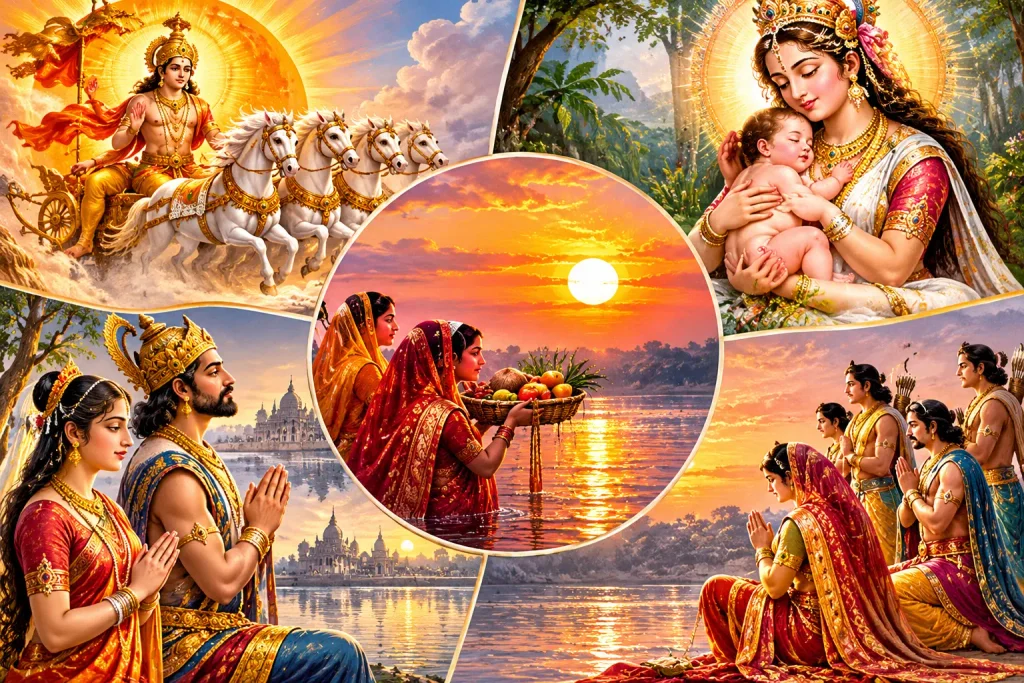
Several mythological stories are associated with the worship of Surya Dev and Chhathi Maiya. These stories have been passed down through religious traditions, folklore and regional interpretations.
Although they are important to understanding the cultural imagination surrounding Chhath, they should be understood as traditional religious narratives rather than independently established historical accounts of the festival’s origin.
◆ Karna and Surya Dev
One of the most widely discussed connections between Sun worship and the Mahabharata is the story of Karna.
Karna was the son of Surya Dev and Kunti. According to the Mahabharata, he possessed extraordinary qualities, including courage, generosity and remarkable skill as a warrior.
He is traditionally associated with devotion to Surya Dev and is remembered for offering prayers to his divine father.
Popular Chhath traditions connect Karna’s devotion and Sun worship with the origins of the festival. His association with the Sun makes him an important figure in stories explaining the significance of Surya worship.
The story also reflects values such as dedication, generosity and gratitude.
◆ Lord Rama and Goddess Sita
Another popular belief connects Chhath Puja with Lord Rama and Goddess Sita.
According to a traditional account, after returning to Ayodhya following their victory over Ravana, Lord Rama and Goddess Sita observed a fast and performed a ritual dedicated to the Sun God.
This story is often associated with the Kartik Shukla Shashthi period and is remembered in regional explanations of the festival.
It reflects the belief that worshipping Surya Dev is an expression of gratitude and a way of seeking divine blessings for prosperity and well-being.
◆ Draupadi and the Pandavas
The Mahabharata also contains traditions connecting Draupadi and the Pandavas with Surya worship.
During their period of exile, the Pandavas faced numerous difficulties. In a popular account, Draupadi sought guidance from Sage Dhaumya regarding their hardships.
She was advised to worship Surya Dev and seek his blessings. The story is associated with faith, perseverance and the belief that sincere devotion can provide strength during difficult circumstances.
The Mahabharata also describes Surya’s blessings to Yudhishthira through the Akshaya Patra, a vessel associated with an inexhaustible supply of food.
These narratives have contributed to the association between Surya worship, nourishment and protection.
◆ Goddess Shashthi and the Story of King Priyavrat
An important traditional account concerning Goddess Shashthi appears in Puranic religious traditions.
According to the story, King Priyavrat and his wife Malini were unable to have a child. After performing a sacrifice, they were blessed with a son, but the child was born lifeless.
The king and queen were overcome with grief. At that moment, Goddess Shashthi appeared and restored the child’s life through her divine grace.
She also explained her identity and her association with the protection of children and the blessings of motherhood.
The king worshipped the goddess, and her worship gradually became associated with the welfare of children and families.
This story is particularly significant in understanding why Chhathi Maiya is worshipped during Chhath Puja.
✦ The Four Days of Chhath Puja: Complete Rituals Explained
Chhath Puja is observed over four days, with each day having its own name, preparations and religious significance.
The four stages are Nahay Khay, Kharna, Sandhya Arghya and Usha Arghya.
◆ Day One – Nahay Khay: The Beginning of Purification
Nahay Khay marks the beginning of Chhath Puja.
The term combines two words: Nahay, meaning to bathe, and Khay, meaning to eat.
On this day, devotees take a ritual bath, often in a river, pond or another suitable water body. They clean their homes, particularly the kitchen and areas where the prasad will be prepared.
Cleanliness is considered extremely important because the food and offerings prepared during Chhath are treated as sacred.
A traditional meal commonly includes rice, chana dal and pumpkin vegetable, often prepared without onion and garlic. In many households, the food is cooked using traditional methods and served after prayers.
The meal marks the beginning of the festival’s dietary discipline.
Spiritual significance: Nahay Khay represents physical and mental preparation. It reminds devotees that purity, discipline and cleanliness are essential parts of their devotional journey.
◆ Day Two – Kharna: Fasting, Prayer and Prasad
The second day is known as Kharna or Lohanda and Kharna.
Devotees observe a fast throughout the day, traditionally without food and water. In the evening, after completing the prescribed worship, they prepare and offer special prasad.
The traditional Kharna meal commonly includes jaggery-based rice kheer, chapati or roti and fruits. The preparation is kept simple and follows the family’s religious customs.
After the offering, the prasad is consumed by the devotee and distributed among family members and others.
Following Kharna, the main extended Nirjala fast begins. Traditionally, this fast continues until the morning rituals of the fourth day are completed.
The approximately 36-hour period without food and water is one of the most demanding aspects of Chhath Puja.
Spiritual significance: Kharna represents restraint, dedication and self-discipline. It marks the transition from the initial preparation to the most rigorous part of the observance.
◆ Day Three – Sandhya Arghya: Offering Prayers to the Setting Sun
The third day is one of the most important moments of Chhath Puja.
Families prepare traditional offerings, arrange fruits and sweets in bamboo baskets and make their way towards rivers, ponds or designated Chhath ghats.
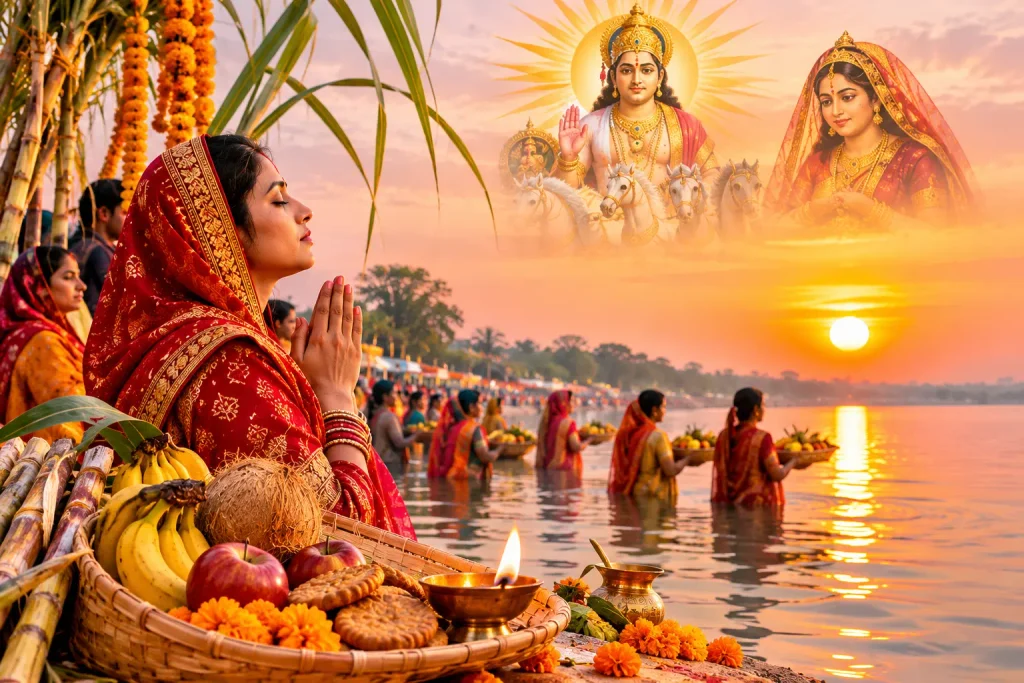
As the evening approaches, devotees stand in the water, often up to their waists, and offer Arghya to the setting Sun.
Arghya is a ritual offering of water, accompanied by prayers and traditional offerings.
The offerings may include milk, water, fruits, Thekua and other sacred food items, according to family and regional customs.
Women and men observing the fast participate in the ceremony, while family members and other devotees gather around them.
Traditional Chhath songs are sung, expressing devotion to Surya Dev and Chhathi Maiya. These songs also preserve memories of family relationships, motherhood, village life and cultural traditions.
In several communities, a special ritual called Kosi is also performed during the night. A decorative structure is prepared using sugarcane stalks, earthen lamps and offerings. Its form and associated practices differ across families and regions.
Spiritual significance: Sandhya Arghya expresses gratitude towards the setting Sun. It recognises the importance of the entire solar cycle and reminds devotees to appreciate the energy and nourishment received throughout the day.
◆ Day Four – Usha Arghya: Prayers to the Rising Sun and Parana
The fourth and final day begins before sunrise.
Devotees return to the riverbanks or designated water bodies while continuing their fast. As the first rays of sunlight appear, they offer Arghya to the rising Sun.
This ritual is called Usha Arghya.
The offerings are presented with prayers to Surya Dev and Chhathi Maiya. Devotees seek blessings for good health, prosperity, longevity and the well-being of their families.
After completing the morning worship, the vrati concludes the fast through a ritual known as Parana.
Prasad is distributed among family members, relatives, neighbours and other devotees.
The completion of the fast marks the conclusion of the four-day observance.
Spiritual significance: Usha Arghya represents renewal, hope and the continuation of life. After expressing gratitude to the setting Sun, devotees welcome the rising Sun with prayers for a new beginning.
✦ Chhath Puja Samagri: Traditional Offerings and Their Significance
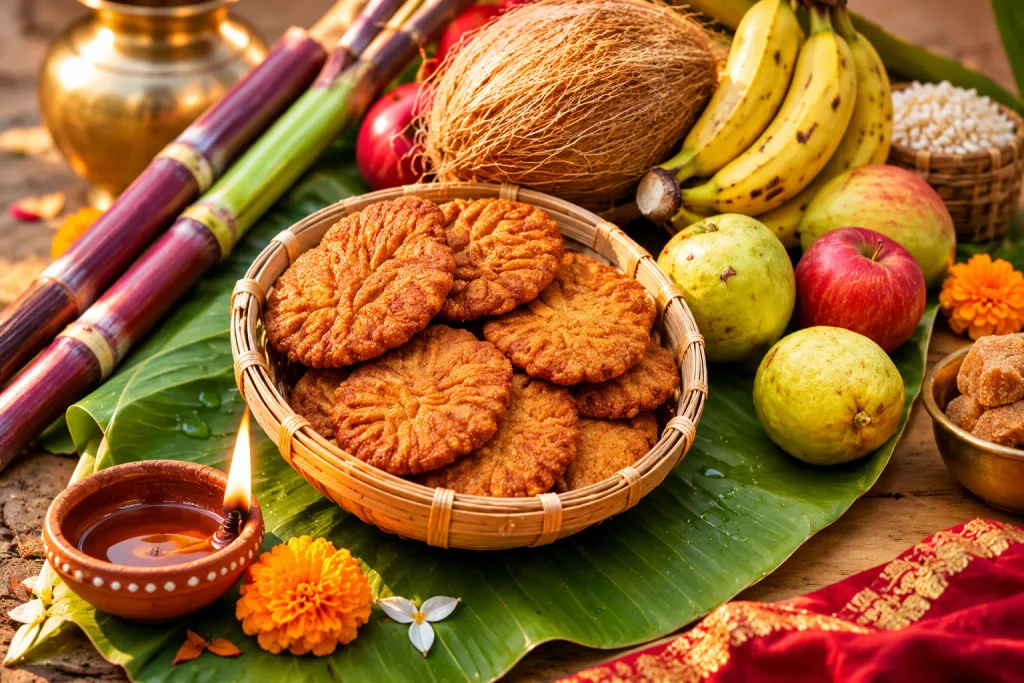
The offerings prepared for Chhath Puja are an important part of the festival. They are traditionally arranged in bamboo baskets called Soop or Dala and carried to the riverbanks for the Arghya ceremonies.
Although the exact items may vary according to regional and family traditions, several offerings are commonly associated with the festival.
Soop and Daura: These traditional bamboo baskets are used to carry fruits, sweets and other offerings. Bamboo craftsmanship is an important part of the festival’s cultural heritage.
Thekua: Thekua is one of the most recognisable foods associated with Chhath Puja. It is a traditional sweet prepared using wheat flour, jaggery or sugar, ghee and sometimes fennel seeds. It is offered to the deities and distributed as prasad.
Kasar: Kasar is a traditional sweet preparation generally made using rice flour and jaggery. Its preparation varies across regions.
Coconut: Coconut is a commonly offered fruit in Hindu worship and forms an important part of Chhath offerings.
Bananas: Bananas are frequently included in the Soop and are among the most familiar fruits offered during the festival.
Sugarcane: Sugarcane is closely associated with the festival and is used in offerings as well as certain decorative structures at the ghats.
Seasonal fruits: Apples, oranges, sweet lime, lemons, pomegranates and other locally available fruits may be included.
Diya: Earthen lamps are used to create a devotional atmosphere and are particularly visible during evening rituals.
Milk and water: These are used in the Arghya ceremony according to local practices.
The offerings reflect the agricultural character of the region and the importance of natural produce in everyday life. They also demonstrate how food, family traditions and religious devotion are connected during Chhath.
✦ How to Perform Chhath Puja: A Step-by-Step Guide
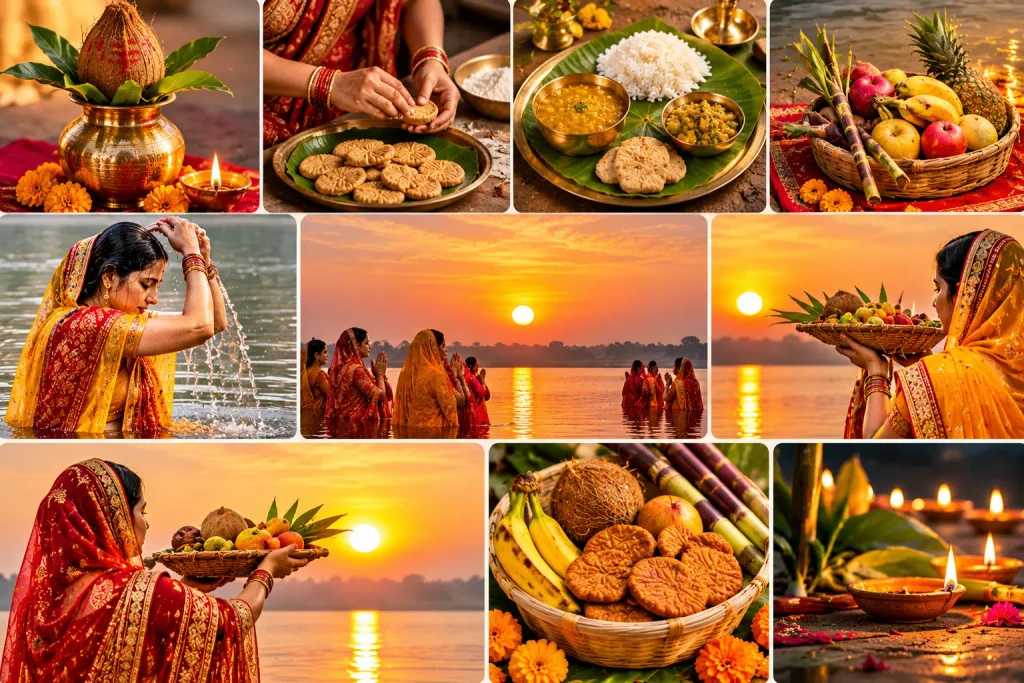
For anyone unfamiliar with the festival, understanding the sequence of rituals can make Chhath Puja easier to appreciate.
Although the exact method varies among communities, the general observance follows a traditional four-day sequence.
◆ Prepare the home and puja area
Clean the house, kitchen and designated areas where prasad will be prepared. Arrange the necessary ingredients and traditional utensils.
◆ Observe Nahay Khay
Take a ritual bath and prepare the traditional sattvik meal. Follow the family’s established practices for beginning the observance.
◆ Complete Kharna
Observe the day-long fast and prepare the traditional evening prasad. Offer it through the prescribed prayers before consuming it.
◆ Prepare the offerings for Arghya
Prepare Thekua, Kasar and other traditional items. Arrange fruits, sugarcane, coconuts and other offerings in the Soop and Daura.
◆ Perform Sandhya Arghya
Visit a suitable ghat or water body in the evening. Stand safely in the water, where appropriate, and offer prayers to the setting Sun.
◆ Perform Usha Arghya
Return before sunrise on the final day and offer prayers to the rising Sun.
◆ Complete Parana
After completing the morning rituals, conclude the fast according to family tradition and distribute prasad.
Chhath Puja is traditionally observed with considerable discipline. Anyone considering the rigorous fast should understand its physical demands. Prolonged fasting without water can cause dehydration and other health complications. People with medical conditions, pregnant individuals, children and older adults should not undertake such fasting without appropriate medical guidance. Religious devotion does not require putting one’s health at risk.
✦ Why Is Chhath Puja Performed Near Rivers and Water Bodies?
Water plays an essential role in the rituals of Chhath Puja.
Devotees traditionally gather near rivers, ponds and other water bodies to offer Arghya to the Sun. The practice brings together two fundamental elements of life: sunlight and water.
In Hindu religious thought, water is associated with purification, continuity and the source of life. Rivers, particularly the Ganga, also hold immense spiritual importance.
Standing in water while offering prayers creates a setting in which devotees experience the natural surroundings as part of their worship.
The ritual also reflects the dependence of agriculture and human communities on rivers and water resources.
In contemporary celebrations, many communities use designated ghats, ponds and other safe water bodies. The emphasis should always remain on cleanliness, safe access and the protection of these natural resources.
✦ Chhath Puja, Traditional Food and Folk Songs
Chhath Puja is not only a religious festival but also an important expression of regional food culture and folk heritage.
Traditional preparations are made with particular care, following the dietary customs of the observing family. Ingredients such as wheat, rice, jaggery, milk and seasonal fruits are commonly used.
Thekua has become especially synonymous with Chhath Puja. Its preparation is often a family activity in which several generations participate.
The traditional songs of Chhath are equally significant.
Folk songs in Bhojpuri, Maithili, Magahi and other regional languages describe the devotion of the vrati, the blessings of Chhathi Maiya, the importance of Surya Dev and the emotional bonds within families.
Many songs are passed down orally from one generation to another. They preserve regional language, cultural memories and devotional expressions that might otherwise gradually disappear.
For people living away from their ancestral homes, these songs and food traditions can be particularly meaningful. They create a connection with family memories, childhood celebrations and their cultural roots.
✦ Chhath Puja Across Different Regions
Although Bihar is particularly associated with Chhath Puja, the festival is celebrated across several regions.
Bihar: Chhath Puja holds exceptional cultural and religious importance in Bihar. Riverbanks, ponds and community ghats become central places of worship. Patna, especially along the Ganga, witnesses large gatherings of devotees.
Jharkhand: The festival is celebrated with devotion in many towns and villages. Families follow the four-day rituals, while local communities organise preparations at ponds and ghats.
Eastern Uttar Pradesh: Chhath Puja is particularly popular in the Bhojpuri-speaking regions. Traditional songs, family customs and the preparation of Thekua form important parts of the celebrations.
Nepal: Chhath is observed with devotion, particularly in the Terai region. The festival is an important expression of cultural and religious heritage.
Delhi and Other Indian Cities: Communities originating from Bihar, Jharkhand and eastern Uttar Pradesh have helped establish Chhath celebrations in major cities. Designated water bodies and community ghats become gathering places for the rituals.
Despite regional differences, the central elements remain similar: devotion to Surya Dev, worship of Chhathi Maiya, traditional offerings, fasting and prayers at sunset and sunrise.
✦ Chhath Puja and Its Connection with Nature and the Environment
One of the most meaningful aspects of Chhath Puja is its close relationship with the natural world.
The festival places the Sun, water, agricultural produce and seasonal food at the centre of its rituals.
The traditional use of bamboo baskets, natural ingredients, fruits and sugarcane reflects the importance of locally available resources. The preparation of prasad also demonstrates how agricultural produce becomes part of religious and cultural life.
The importance of cleanliness is another defining feature. Homes and kitchens are cleaned before the festival, and communities often come together to prepare public ghats and surrounding areas.
However, the environmental message of Chhath Puja should extend beyond the festival itself.
Rivers and ponds must remain clean throughout the year, not only during religious celebrations. Devotees and organisers can support this principle by avoiding plastic decorations, disposing of offerings responsibly and preventing waste from entering water bodies.
The festival provides an opportunity to reflect on the responsibility human beings have towards the natural resources that sustain them.
Its message is particularly relevant today, when water pollution, environmental degradation and the misuse of natural resources have become major concerns.
✦ What Makes Chhath Puja Different from Other Hindu Festivals?
Chhath Puja has several distinctive characteristics that make it stand apart from many other Hindu festivals.
First, the Sun is worshipped directly in the open environment, rather than the principal rituals being centred around an indoor temple setting.
Second, devotees offer prayers to both the setting and rising Sun, recognising the importance of the entire solar cycle.
Third, the festival places exceptional emphasis on personal discipline, cleanliness and the preparation of traditional offerings.
Fourth, the participation of the wider community is central to the celebration. Even people who do not observe the fast often contribute by preparing food, organising ghats, assisting devotees and distributing prasad.
Finally, the festival has a strong connection with regional identity, particularly in Bihar and neighbouring areas. Its folk songs, traditional food and family practices make it an important part of cultural heritage.
Together, these characteristics give Chhath Puja its distinctive spiritual and social identity.
✦ Conclusion: Chhath Puja – A Celebration of Faith, Gratitude and Nature
Chhath Puja represents a relationship between humanity, nature and the divine that has been preserved through generations.
Its rituals may appear demanding, particularly the extended fasting and the discipline required over four days. Yet the festival’s deeper significance lies in the values it celebrates: gratitude, purity, patience, family, devotion and respect for the natural world.
The image of devotees standing in water as the evening Sun disappears beyond the horizon, followed by their return before dawn to welcome the rising Sun, captures the spirit of this festival beautifully.
It reminds us that life is sustained by forces greater than ourselves and that gratitude should not be limited to moments of personal happiness or achievement.
Through the worship of Surya Dev and Chhathi Maiya, Chhath Puja teaches the importance of appreciating life’s essential gifts, respecting nature and maintaining faith through every phase of existence.
Perhaps that is what makes this festival so enduring. Beyond its rituals and traditions, Chhath Puja carries a timeless message: honour the forces that give life, remain grateful for what sustains you, and preserve the traditions that connect generations.
At Life Unfiltered Stories, we believe that understanding a festival means looking beyond its celebrations to discover the history, faith and values that give it meaning. Chhath Puja is one such tradition, where devotion and nature come together in a beautiful expression of gratitude.
✦ Frequently Asked Questions About Chhath Puja
◆ Why is Chhath Puja celebrated?
Chhath Puja is celebrated to worship Surya Dev and Chhathi Maiya. Devotees express gratitude for the Sun’s life-sustaining energy and seek blessings for health, prosperity, longevity and family well-being.
◆ Who is worshipped during Chhath Puja?
The principal deity is Surya Dev, the Sun God. Chhathi Maiya, commonly associated with Goddess Shashthi, is also worshipped for the protection and welfare of children and families.
◆ Why do devotees worship the setting Sun?
Devotees offer Arghya to the setting Sun as an expression of gratitude. The ritual recognises the importance of the Sun throughout its daily journey and is followed by prayers to the rising Sun the next morning.
◆ Why is Chhath Puja celebrated for four days?
The four days represent a sequence of purification, fasting, evening worship and morning worship. Each day has a specific ritual: Nahay Khay, Kharna, Sandhya Arghya and Usha Arghya.
◆ What is Nahay Khay?
Nahay Khay is the first day of Chhath Puja. Devotees take a ritual bath, clean their homes and prepare a simple traditional vegetarian meal.
◆ What is Kharna?
Kharna is the second day of the festival. Devotees observe a day-long fast and break it in the evening after preparing and offering traditional prasad, commonly jaggery-based kheer and roti.
◆ What is the significance of Thekua?
Thekua is a traditional sweet prepared using wheat flour and jaggery or sugar. It is one of the most important offerings during Chhath Puja and is distributed as prasad.
◆ Can unmarried women observe Chhath Puja?
Yes. Chhath Puja is not restricted to married women. Men and women, including unmarried women, can participate according to their beliefs and family traditions.
◆ Is Chhath Puja celebrated twice a year?
Yes. Chhath is observed during Kartik and Chaitra in many traditions. Kartik Chhath is generally the more widely celebrated observance, while the spring observance is known as Chaiti Chhath.
◆ What is Parana in Chhath Puja?
Parana is the ritual conclusion of the fast. It takes place after the final morning Arghya to the rising Sun, following the prescribed family or regional tradition.
◆ What is the difference between Sandhya Arghya and Usha Arghya?
Sandhya Arghya is the evening offering made to the setting Sun on the third day. Usha Arghya is the morning offering made to the rising Sun on the fourth day.
◆ What is the significance of Chhathi Maiya?
Chhathi Maiya is associated with Goddess Shashthi in popular traditions. Devotees worship her for the protection of children, motherhood, fertility and family well-being.