
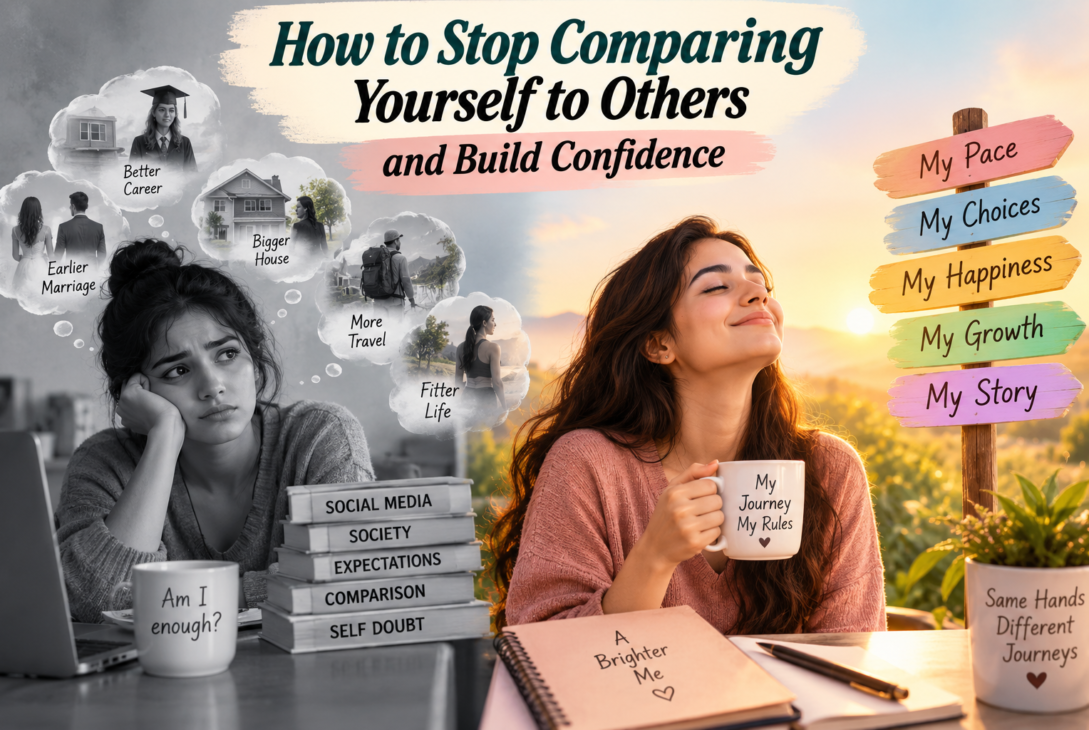
How to Stop Comparing Yourself to Others
Have you ever looked at someone else’s life and suddenly wondered whether you’re falling behind?
Perhaps someone younger than you is achieving things you haven’t yet. A friend is getting married, a neighbour is building a house, or someone you once knew is enjoying the kind of success you imagined for yourself.
Suddenly, your own progress seems smaller.
The strange thing is that nothing may have gone wrong in your life. Yet, after looking at someone else’s achievements, you begin questioning your own decisions, timeline, and abilities.
This is how comparison quietly affects confidence.
Comparing yourself to others is natural, but allowing it to decide how you feel about your life can become exhausting. The good news is that you can learn how to stop comparing yourself to others and build confidence by changing the way you measure progress, success, and personal growth.
Let’s explore how.
Why Do We Compare Ourselves to Others?
Comparison doesn’t always begin with jealousy or insecurity. Sometimes, it begins with something much more familiar: the desire to understand whether we’re doing enough.
We look around to see how others are living, what they’ve achieved, and where we stand in relation to them. Over time, these observations can become an invisible competition.
Society often makes this worse.
Someone gets excellent marks, and suddenly every other student is expected to perform the same way. A neighbour buys a house, and another family feels pressured to build one too—even when it creates financial stress. When everyone around us is getting married, we may begin wondering whether something is wrong with our own timeline.
The pressure to fit in can make comparison feel less like a choice and more like an obligation.
But here’s something worth remembering: A life that looks successful to society may not necessarily be the life that feels right for you.
How Society Turns Life Into a Competition
Society often creates an unwritten checklist for how life should unfold.
Study well. Get a good job. Get married at the expected age. Buy a house. Have children. Earn more. Keep up with everyone around you.
There’s nothing wrong with these milestones when they genuinely reflect what someone wants. The problem begins when people pursue them only because they fear being judged for choosing differently.
You may take a loan you cannot comfortably afford because someone else has built a beautiful home. You may rush into a relationship because everyone around you seems settled. You may question your career simply because your peers appear further ahead.
This is where comparison becomes harmful.
You stop asking, “What is right for my life?” and start asking, “What do I need to do to look like everyone else?”
And in that process, your own peace can become the price of fitting in.

How Comparing Yourself to Others Affects Your Confidence
Constant comparison can change the way you see yourself.
Instead of recognizing your strengths, you begin focusing on what you lack. Instead of appreciating your progress, you notice how far you think you still have to go.
Over time, this can lead to:
- Doubting your decisions.
- Feeling disappointed with your own life.
- Losing motivation.
- Believing you’re not doing enough.
- Measuring your worth through achievements that belong to someone else.
The most frustrating part is that comparison rarely gives you a finish line. Even when you achieve something, there will always be someone earning more, travelling further, looking different, or reaching another milestone sooner.
If your confidence depends on staying ahead of everyone else, peace will always feel temporary.
Social Media Can Make You Feel Further Behind
Social media has made comparison almost impossible to avoid.
You open your phone and see people celebrating achievements, travelling to beautiful places, launching businesses, getting married, or transforming their lives.
And sometimes, you wonder:
“People younger than me are achieving so much. Where do I stand?”
That feeling is real, and pretending otherwise doesn’t help.
But we must also remember that social media rarely shows the complete picture. It shows moments, outcomes, celebrations, and carefully selected experiences. It doesn’t always reveal the struggles, financial circumstances, support systems, failures, or time invested behind them.
This doesn’t mean someone else’s success is fake.
It simply means their visible progress is not a complete measurement of your invisible journey.
The next time social media makes you question yourself, pause and remember: you’re looking at a small part of someone else’s life while judging the entirety of your own.
Everyone Has a Different Question Paper in Life

Your journey doesn’t have to follow the crowd. Trust your direction and embrace your own pace.
One perspective that has helped me understand comparison differently is this:
Everyone has a different question paper in life.
Think about it. If two students receive completely different examination papers, can we fairly judge their performance using the same expectations without understanding their circumstances?
Life works in a similar way.
Every person has different opportunities, responsibilities, family situations, financial conditions, challenges, priorities, and starting points.
Even when two people face a similar problem, their solutions may look completely different.
Think about something as simple as preparing food. Every household has its own way of cooking. The ingredients, methods, and preferences may differ, but that doesn’t mean one kitchen is living incorrectly.
Life is much the same.
Someone may begin their career at 19, while another person discovers their direction at 29. Someone may have family support that makes a decision easier, while another person must carry responsibilities that others never see.
So how can we use someone else’s timeline as the final judgment of our own?
Your journey deserves to be understood before it is evaluated.
How to Stop Comparing Yourself to Others and Build Confidence
Understanding comparison is helpful, but changing the habit requires practical steps.
Here are some ways to begin.
1. Identify What Triggers Your Comparisons
Pay attention to when comparison appears.
Is it after scrolling through social media? During family gatherings? When discussing careers, marriage, money, or personal achievements?
Recognizing your triggers helps you understand what is affecting your confidence.
You cannot change a pattern you haven’t noticed.
2. Stop Using Society’s Timeline to Measure Your Life
Ask yourself whether you genuinely want something or simply feel pressured to pursue it because everyone else is doing it.
A milestone becomes meaningful when it reflects your values—not when it satisfies someone else’s expectations.
You don’t have to reject society’s traditions or opinions. You simply need to decide which ones deserve control over your choices.
3. Compare Yourself With Your Previous Self
Instead of constantly asking, “Why am I not where they are?” try asking:
- What have I learned this year?
- What difficult decision have I handled?
- What habits have improved?
- What did I once fear that I can now face?
- Am I moving closer to the life I genuinely want?
Personal growth isn’t always visible from the outside.
Sometimes, progress is leaving an unhealthy environment, learning a new skill, rebuilding confidence, or taking the first step toward something meaningful.
These achievements deserve recognition too.
4. Learn to Admire Others Without Abandoning Yourself
Someone else’s success doesn’t have to become evidence of your failure.
You can appreciate another person’s achievements, learn from their journey, and feel happy for them without deciding that your own life is inadequate.
Inspiration says, “That’s possible for me too.”
Unhealthy comparison says, “If I don’t have that, I’m not enough.”
Learn to recognize the difference.

5. Build Confidence Through Small Promises You Keep
Confidence doesn’t appear only after achieving something extraordinary.
It also grows when you begin trusting yourself.
Set realistic goals. Follow through on commitments. Make decisions aligned with your values. Acknowledge your efforts, even when results take time.
Every small promise you keep sends yourself a message:
“I can rely on me.”
That is a much stronger foundation for confidence than trying to impress everyone around you.
6. Protect Yourself From Unnecessary Comparison
If certain accounts, conversations, or environments consistently leave you feeling inadequate, create some distance.
You don’t have to disconnect from the world completely. But you can become more intentional about what you consume and whose opinions you allow to influence your self-image.
Protecting your peace is not avoiding reality.
Sometimes, it is creating enough mental space to see your own reality clearly.
Don’t Burn Your Own House While Admiring Someone Else’s Mansion
My father has always shared a thought that carries a powerful lesson:
“Don’t burn your own house while looking at someone else’s mansion.”
To me, this is what unhealthy comparison often looks like.
You admire someone else’s life so intensely that you begin damaging your own peace, finances, confidence, or identity just to match it.
There’s nothing wrong with appreciating someone else’s achievements.
But if trying to keep up requires you to sacrifice everything that matters to you, it’s worth pausing and asking whether the goal is truly yours.
You can respect your parents, elders, traditions, and society while still making choices that feel right for your own life.
Because if something goes wrong, you should at least be able to say:
“This was my decision. This was the life I chose to build.”
Build Confidence by Living Life on Your Own Terms
Learning how to stop comparing yourself to others doesn’t mean you’ll never experience self-doubt again.
It means you become better at recognizing when comparison is pulling you away from your own values.
You begin measuring success through personal growth, meaningful decisions, and the life you are genuinely trying to create.
Your timeline may look different. Your priorities may change. Your path may take unexpected turns.
That doesn’t make your journey less valuable.
Final Though
Life is not a race where everyone starts at the same point, follows the same route, and reaches the same destination.
Just as the five fingers of your hand are different yet belong to the same hand, every person’s journey has its own shape, purpose, and challenges.
You don’t need to follow someone else’s timeline to prove that you’re progressing.
You don’t need to sacrifice your peace to fit into society’s expectations.
And you certainly don’t need to lose confidence because someone else reached a milestone before you.
Live your life with awareness. Respect others, learn from them, but don’t forget to choose your own direction.
Because you have one life—and it deserves to be lived in a way that feels meaningfully yours.