
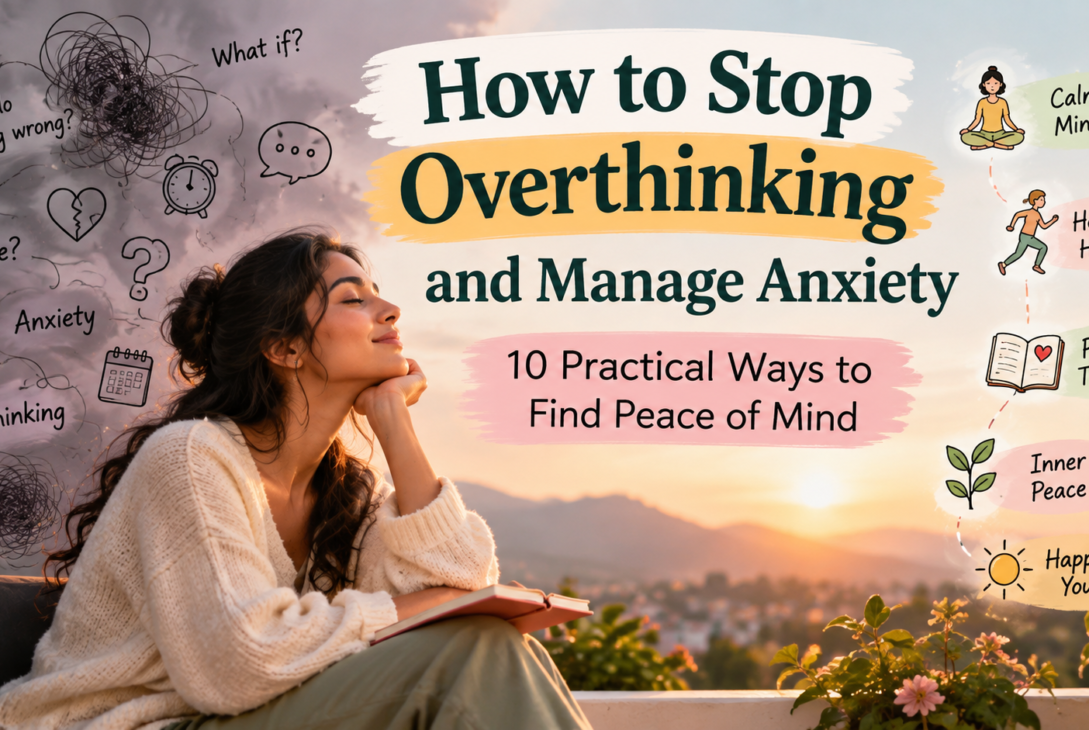
How to Stop Overthinking
The 50 Shades of Overthinking
Have you ever gone to bed feeling physically tired but found your mind wide awake, replaying conversations, questioning decisions and imagining situations that haven’t even happened?
Perhaps you keep wondering whether you said something wrong, whether someone misunderstood you or whether tomorrow will bring a problem you aren’t prepared to handle.
And sometimes, the situation isn’t even negative. You might be excited about a new relationship, an upcoming wedding, a career opportunity or a fresh beginning, yet your mind keeps moving between excitement, nervousness and endless possibilities.
That’s the interesting thing about overthinking. It doesn’t always arrive with sadness or fear. It has many shades.
Sometimes, it looks like worrying about an important meeting. Sometimes, it means imagining every possible problem before making a decision. It can even appear as excessive concern for the people we love. Parents waiting for their daughter to return home late at night, for example, may imagine several situations simply because they care about her safety.
Different people, different circumstances, but one common experience: the mind keeps creating possibilities, even when there is nothing we can immediately do about them.
Our thinking patterns are influenced by many things, including childhood experiences, family environments, relationships, disappointments, personal expectations and the information we consume every day. Over time, these experiences can shape how we interpret situations and respond to uncertainty.
But when thinking becomes repetitive, distressing and difficult to manage, it can affect our sleep, confidence, relationships and everyday peace of mind.
So, how do you stop overthinking without constantly fighting your own thoughts?
The answer isn’t to become someone who never worries. It’s to understand your thought patterns, recognise what triggers them and learn healthier ways to respond.
In this guide, we’ll explore why overthinking happens, how it connects with anxiety and ten practical ways to build a calmer relationship with your mind.
Because sometimes, peacebegins when you stop trying to control every thought and start understanding what your mind actually needs.

What Is Overthinking and Why Does It Happen?
Overthinking is a pattern of repeatedly analysing situations, decisions, experiences or possible outcomes, often without reaching a useful conclusion.
It can involve replaying something that happened in the past, worrying about a present situation or imagining problems that might occur in the future.
For example, imagine sending someone a message and not receiving a reply.
Initially, you might think they’re busy. But after some time, your mind starts asking questions:
- Did I say something wrong?
- Are they upset with me?
- Have I done something to disappoint them?
- What if they no longer want to talk?
The original situation hasn’t changed. Yet your thoughts have turned a simple unanswered message into several possible problems.
This is one way overthinking develops: uncertainty creates questions, and repetitive thinking keeps searching for answers that may not even be available.
Common Reasons Behind Overthinking
There isn’t one reason why everyone overthinks. Different experiences and circumstances can contribute to repetitive thinking.
1. Fear of the unknown
Not knowing what will happen can feel uncomfortable. We may imagine several possible outcomes because we believe anticipating every problem will protect us from disappointment.
2. The need to control everything
When we expect situations to unfold exactly as planned, uncertainty can become difficult to accept. We repeatedly analyse decisions because we want to avoid mistakes or unexpected outcomes.
3. Past experiences
Rejection, criticism, disappointment and broken trustcan influence how we approach new situations. Sometimes, our minds remain alert to similar experiences because we don’t want to feel that pain again.
4. Insecurity and low self-confidence
When we constantly question our abilities or decisions, even small situations can feel complicated. We may seek repeated reassurance because trusting ourselves becomes difficult.
5. Childhood and environmental influences
The way we observe people responding to stressful situations while growing up can influence our own thinking patterns. Our surroundings and repeated experiences may also shape how we understand relationships, safety and uncertainty.
6. Information overload
Constant exposure to alarming news, social media discussions, negative conversations and other people’s experiences can add to mental overload. Sometimes, we start worrying about situations that aren’t even part of our lives.
Understanding your triggers doesn’t mean blaming yourself or your past. It simply gives you a starting point for recognising what happens inside your mind.
How Are Overthinking and Anxiety Connected?

“When your thoughts stop racing, peace finally gets a chance to speak.” — LUS
Overthinking and anxiety often occur together, but they are not the same thing.
Overthinking involves repetitive thoughts about situations, decisions or possible outcomes. Anxiety involves feelings of fear, apprehension or excessive worry and can also include physical symptoms such as restlessness, muscle tension, difficulty concentrating or a racing heartbeat.
Sometimes, overthinking can increase anxiety. In other situations, anxiety can make it harder to stop thinking about possible threats.
Consider someone who has an important work meeting approaching.
They may begin worrying about their performance, targets, mistakes or how their manager will respond. As the meeting gets closer, the thoughts become increasingly difficult to manage.
They might experience difficulty sleeping, physical tension or a feeling of breathlessness.
Similar experiences can happen before marriage, during financial difficulties, in relationships or when dealing with family expectations.
Sometimes, the circumstances themselves are genuinely stressful. A difficult workplace, an unhealthy relationship or constant pressure can contribute to emotionaldistress. In such situations, changing your surroundings, establishing boundaries or seeking support may be just as important as changing your thinking habits.
It’s also important to understand that anxiety can have several contributing factors. It isn’t always caused by overthinking, and it isn’t something everyone can simply switch off.
If anxiety becomes persistent, overwhelming or starts affecting everyday life, professional support can help.
10 Practical Ways to Stop Overthinking and Calm Your Mind
You don’t need to change your entire life in one day to develop a calmer mind.
Small, consistent changes can help you recognise unhelpful thought patterns and respond to them differently.
Here are ten practical approaches worth trying.
1. Recognise When Your Thoughts Become a Cycle
One of the first steps towards learning how to stop overthinking is recognising when ordinary thinking turns into repetitive worry.
Sometimes, we become so accustomed to analysing everything that we don’t notice how much time we’re spending on the same thoughts.
You might find yourself:
- Replaying old conversations repeatedly.
- Imagining negative outcomes before something happens.
- Questioning every decision you make.
- Constantly wondering what other people think.
- Creating imaginary situations and reacting emotionally to them.
The next time this happens, pause and ask yourself:
- Am I trying to solve something or repeating the same thoughts?
- Is there any new information that I’m considering?
- Can I take a practical step right now?
- Am I worrying about something that hasn’t happened?
Recognising a thought cycle doesn’t automatically make it disappear, but it helps you notice when your mind is no longer moving towards a useful solution.
LUS Mind Reset: Write down the thought that keeps returning. Identify what triggered it and whether there’s anything you can actually do about it.
2. Separate Facts from Assumptions
A thought can feel convincing without necessarily being true.
Imagine that a friend hasn’t responded to your message. You immediately begin wondering whether they’re angry, disappointed or avoiding you.
But what do you actually know?
The only confirmed information is that you haven’t received a reply.
Everything else is an assumption.
When you catch yourself creating explanations, try separating facts from possibilities.
Ask yourself:
- What actually happened?
- What am I assuming?
- Are there other reasonable explanations?
- Do I have enough information to reach a conclusion?
For example:
Fact: My colleague hasn’t responded to my email.
Assumption: They must be unhappy with my work.
Other possibilities: They may be busy, unavailable or waiting for additional information.
This approach doesn’t mean ignoring genuine problems. It means giving yourself enough space to understand a situation before reacting to an imagined explanation.
Remember, not every thought deserves to become a conclusion.
3. Stop Trying to Control Every Outcome
Do you ever feel that everything needs to happen according to your expectations?
You want the conversation to go perfectly, your work to receive appreciation, your relationships to remain secure and your future to unfold exactly as planned.
But life doesn’t always cooperate with our expectations.
Sometimes, even after making careful plans, circumstances change. People behave differently, opportunities disappear and unexpected responsibilities arise.
When this happens, we may spend hours thinking about what should have happened instead of understanding what we can do now.
Try changing the questions you ask yourself.
Instead of repeatedly asking, “Why didn’t things happen the way I wanted?”, consider:
- What is still within my control?
- What can I learn from this situation?
- Is there anything I can change?
- What should my next practical step be?
Acceptance doesn’t mean agreeing with everything that happens. It means recognising the situation as it is and deciding how to respond.
LUS Mind Reset: Divide a page into two columns: Things I Can Control and Things I Cannot Control. Write your current worries under the appropriate heading and focus on the actions available to you.
4. Give Your Worries a Specific Time
Worries can occupy almost every part of the day if we don’t learn how to organise our attention.
You might be having breakfast while thinking about work, watching a movie while worrying about tomorrow or trying to sleep while remembering something that happened several days ago.
One technique worth trying is scheduled worry time.
Set aside approximately 10–15 minutes during the day to think through your concerns.
During this time:
- Write down what’s bothering you.
- Identify which concerns require action.
- Decide whether you can do something about them.
- Make a small plan for anything that needs attention.
If a worry appears outside that period, gently remind yourself that you can return to it during your designated time.
This isn’t about ignoring important problems or suppressing emotions. It’s about preventing every concern from taking over your entire day.
If a problem requires immediate attention, address it rather than postponing it.
5. Bring Your Attention Back to the Present
Overthinking often pulls our attention in two directions: towards the past and towards the future.
We replay conversations that have already happened or imagine situations that haven’t arrived.
Meanwhile, we lose connection with what is happening around us.
Grounding techniques can help bring your attention back to the present moment.
Try the 5-4-3-2-1 grounding exercise:
- 5 things you can see.
- 4 things you can physically feel.
- 3 things you can hear.
- 2 things you can smell.
- 1 thing you can taste.
Take your time with each step.
You can also sit comfortably and pay attention to your natural breathing. There’s no need to force deep breaths. Simply notice the rhythm of your breathing and gently bring your attention back whenever your mind wanders.
The purpose isn’t to make every uncomfortable feeling disappear instantly. It’s to reconnect with the present instead of remaining lost in imagined situations.
6. Write Down What’s Bothering You
Sometimes, our minds feel crowded because we’re trying to hold too many thoughts at once.
Writing can give those thoughts a place to go and help us understand what we’re experiencing.
You don’t need a beautiful journal, perfect handwriting or a special writing routine. A simple notebook is enough.
Start by asking yourself:
- What is bothering me today?
- Why is this situation affecting me?
- What am I afraid might happen?
- Is there something I can do about it?
- What do I need to remind myself?
For example, you might write that you’re worried about an upcoming decision.
As you continue writing, you may realise that you’re not necessarily afraid of the decision itself. You’re afraid of making the wrong choice and dealing with its consequences.
Understanding that difference can help you identify what actually needs attention.
Writing has been a meaningful way of processing thoughts for many people, and it can be particularly useful when speaking about emotions feels difficult.
A Little LUS Reminder: You don’t have to make your thoughts sound organised before writing them down. Let yourself be honest. Sometimes, clarity begins with allowing your thoughts to exist outside your head.
7. Move Your Body Instead of Staying Stuck in Your Thoughts
When your mind feels overloaded, continuing to sit with the same thoughts can make it harder to shift your attention.
Physical activity offers a healthy way to reconnect with your body, change your surroundings and release some accumulated tension.
You don’t need an intense workout or an expensive gym membership.
Try something you genuinely enjoy:
- Go for a walk.
- Join a dance class.
- Practise yoga or gentle stretching.
- Play tennis or badminton.
- Explore a walking trail.
- Try boxing with proper guidance.
For some people, dancing provides an enjoyable way to express emotions. Others prefer walking alone, spending time in nature or following a gentle exercise routine.
The important thing is to choose an activity that feels comfortable and sustainable.
Regular physical activity can support mental well-being and may help reduce symptoms of anxiety. It is not a replacement for professional treatment when treatment is needed.
LUS Mind Reset: When you notice yourself becoming mentally stuck, take a short movement break. Leave your phone aside, walk or stretch gently and return to your task when you’re ready.
8. Be Mindful of the Information You Consume
Think about how much information enters your mind every day.
Social media posts, news updates, online arguments, relationship advice, other people’s opinions and constant notifications can keep your brain occupied even when you’re not actively looking for information.
Sometimes, we absorb other people’s fears and begin applying their experiences to our own lives.
For example, repeatedly watching videos about relationship problems might make you question a healthy relationship. Constantly reading alarming financial news might increase your worries about your own future.
This doesn’t mean avoiding important information. It means becoming more intentional about what you consume.
Try these simple changes:
- Avoid endless scrolling before bedtime.
- Unfollow accounts that repeatedly leave you distressed.
- Take regular breaks from social media.
- Avoid checking notifications every few minutes.
- Choose reliable information sources.
- Spend time doing activities that don’t involve screens.
Your mind needs periods of rest from constant information.
9. Build a Calming Daily Routine
A calmer mind isn’t built through one perfect day. It develops through small habits that you repeat over time.
When your daily routine becomes unpredictable, you may find it difficult to make space for rest, movement and activities that support your well-being.
Start with manageable habits.
In the morning:
- Give yourself a few quiet minutes before checking your phone.
- Practise gentle stretching or yoga.
- Have breakfast without rushing.
- Identify your priorities for the day.
During the day:
- Take short breaks between tasks.
- Go outside for fresh air.
- Eat regular, balanced meals.
- Focus on one task at a time when possible.
In the evening:
- Reduce unnecessary screen time.
- Spend time on something you enjoy.
- Write down unresolved worries.
- Follow a consistent sleep routine.
You don’t need a complicated wellness schedule. Even a few consistent habits can bring more structure to your day.
Be patient with yourself. Building a routine is a process, not another target you must achieve perfectly.
10. Learn to Let Thoughts Pass Without Judging Yourself

This is one of the most important lessonswhen learning how to stop overthinking.
Many people become frustrated because they cannot stop thinking.
They start worrying about something and then become upset with themselves for worrying again.
This creates another layer of mental pressure.
Instead of fighting every thought, practise acknowledging it without immediately reacting.
For example:
“I’m worried about tomorrow. I can acknowledge that feeling without spending the entire evening imagining everything that could go wrong.”
Or:
“I’m remembering something painful from the past, but I don’t have to relive that experience every time it crosses my mind.”
Mindfulness encourages us to notice our thoughts and emotions without automatically judging or reacting to them.
You can practise this by sitting quietly for a few minutes, noticing your thoughts and gently bringing your attention back to your breathing whenever your mind wanders.
And remember, your mind will wander again. That’s part of being human.
The goal isn’t to achieve a completely empty mind. It’s to learn that you don’t have to follow every thought wherever it takes you.
The LUS Approach: Pause. Understand. Release.
Sometimes, managing overthinking becomes easier when we have a simple approach to follow.
At Life Unfiltered Stories, we believe that developing a healthier relationship with your thoughts begins with three small steps.
PAUSE
Give yourself a moment before reacting.
When a thought makes you anxious, don’t immediately believe it or act on it. Stop for a moment, breathe comfortably and recognise what’s happening inside you.
UNDERSTAND
Ask yourself what’s really bothering you.
Is it fear, uncertainty, an old experience or something you cannot control?
Try to identify whether your thoughts are based on facts, assumptions or imagined possibilities.
RELEASE
Focus on what you can influence.
Take practical action where possible. When something is beyond your control, practise allowing uncertainty instead of repeatedly exhausting yourself with imagined outcomes.
Pause. Understand. Release.
This isn’t a promise that every worry will disappear. It’s a reminder that you can gradually learn to respond to your thoughts with greater awareness and patience.
What to Do When Overthinking Returns
Progress doesn’t always happen in a straight line.
You might practise healthier habits for several days and still find yourself worrying about a conversation, questioning a decision or feeling anxious about an unexpected situation.
That doesn’t mean you’ve failed.
Old thinking patterns can return during stressful periods, major life changes or emotionally difficult situations.
When this happens:
- Recognise that you’re experiencing another thought cycle.
- Identify what triggered it.
- Separate what you know from what you’re imagining.
- Choose one small action that can help.
- Allow yourself time to settle without demanding immediate results.
If the same concern keeps returning because there’s a genuine unresolved problem, don’t rely on distraction alone. Think about what practical support, conversation or change might help.
And most importantly, don’t turn managing your thoughts into another reason to judge yourself.
When Should You Seek Professional Help for Overthinking and Anxiety?
Occasional worrying is a normal part of life. However, persistent anxiety and repetitive worrying deserve attention when they begin interfering with everyday activities.
Consider speaking with a qualified mental health professional if:
- You struggle to manage your worries.
- Anxiety regularly affects your sleep.
- You find it difficult to concentrate on everyday responsibilities.
- You experience persistent restlessness or emotional distress.
- Your relationships or work are being affected.
- You feel overwhelmed by thoughts even when you try different coping techniques.
A mental health professional can help you understand what’s happening and recommend appropriate support.
Cognitive Behavioural Therapy (CBT), for example, is an established psychological treatment used for several anxiety-related conditions. Depending on individual needs, other therapies or medication may also be considered.
You don’t have to wait until things become unbearable before asking for help.
Seeking professional support isn’t a sign of weakness. It’s a meaningful step towards taking care of yourself.
Conclusion: Life Is Temporary. Don’t Lose Today Worrying About Tomorrow.
Life is unpredictable.
Some days will unfold exactly as you imagined, while others may take you in a completely unexpected direction.
You might make plans that don’t work out, experience disappointments you never anticipated or face situations that leave you questioning everything.
And during difficult moments, even a small problem can feel enormous. It may seem as though nothing will ever get better.
But difficult moments are not your entire life.
Think about how many situations you once believed you would never get through. Yet, here you are. You’ve experienced changes, learned lessons, made decisions and continued moving forward.
Life is temporary. The good moments pass, and the difficult moments pass too.
So why spend every precious moment worrying about something that hasn’t happened yet?
If you’re worried about your future, take one practical step towards making it better.
If you’re worried about a relationship, have an honest conversation or establish the boundaries you need.
If you’re worried about finances, look at your options, make a plan and seek support where necessary.
If you’re emotionally exhausted, allow yourself to rest.
And if faith is an important part of your life, let prayer, spirituality or your personal beliefs give you strength during uncertain moments. You can have faith and still take practical action.
You don’t need to have every answer today. You don’t need to control every situation. And you certainly don’t need to spend your life preparing for every possible problem.
Appreciate the people who love you. Recognise how far you’ve come. Give yourself permission to enjoy the present.
You cannot control every thought, every situation or every outcome. But you can learn to stop giving every thought the power to control your life.
So, the next time your mind feels overwhelmed, remember:
Pause. Understand. Release.
Take a breath. Give yourself some patience. And come back to the life that’s happening right now.
Because your life deserves to be lived, not just worried about.
With love,
Life Unfiltered Stories (LUS)
Frequently Asked Questions About Overthinking
1. How can I stop overthinking everything?
Start by recognising repetitive thought patterns. Separate facts from assumptions, identify your triggers and focus on practical actions rather than imagining every possible outcome. Journaling, mindfulness and regular physical activity may also help.
2. Why do I overthink even when nothing is wrong?
Overthinking can be influenced by fear, uncertainty, past experiences, insecurity and the desire to control outcomes. Sometimes, your mind continues anticipating problems even when there is no immediate threat.
3. How can I stop overthinking at night?
Create a calming bedtime routine, reduce stimulating screen activities before sleep and write down unresolved worries earlier in the evening. If thoughts arise, gently bring your attention back to your breathing instead of trying to solve everything at bedtime.
4. What is the difference between overthinking and anxiety?
Overthinking describes repetitive thinking about situations or possibilities. Anxiety involves feelings of worry, fear or apprehension and can also include physical symptoms. They can overlap, but they are not interchangeable.
5. Can exercise help reduce overthinking?
Physical activities such as walking, dancing, swimming and yoga can support mental well-being and help manage stress. Choose activities you enjoy and can maintain regularly.
6. How do I stop worrying about things I cannot control?
First, recognise which parts of a situation are outside your influence. Then redirect your attention towards your own decisions, actions and responses. Acceptance takes practice, so be patient with yourself.
7. When should I seek professional help for excessive overthinking?
Consider professional support when persistent worrying or anxiety affects your sleep, relationships, work, concentration or everyday activities. A mental health professional can help identify the underlying concerns and recommend suitable support.