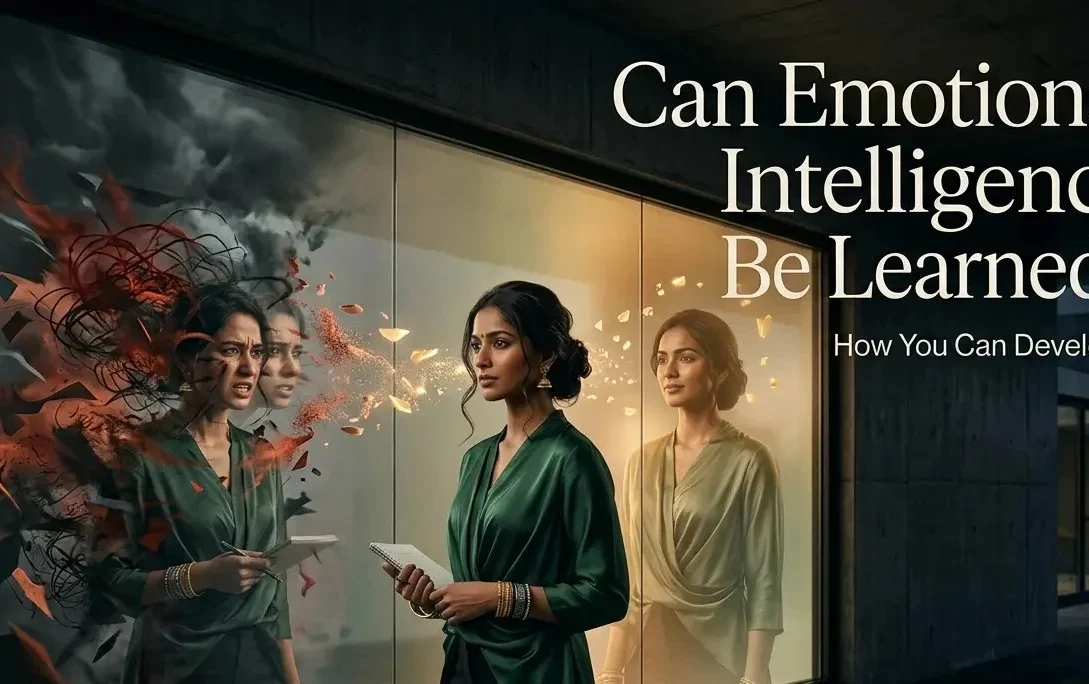
Can Emotional Intelligence Be Learned? Yes, You can
Life is unpredictable. We don’t know what tomorrow will bring, what situation will test us next, or how a particular moment will make us feel. But one thing about life is certain: we are always learning.
Think about it. Learning is almost as essential to being human as breathing. From childhood, we learn how to walk, speak, understand people, handle situations, make mistakes, and try again. So when someone says, “I am just not emotionally intelligent,” or “I can’t change the way I react,” I don’t completely agree.
If you genuinely want to learn, you can.
And that applies to emotional intelligence too.
Emotional Intelligence Can Be Learned
Emotional intelligence isn’t about never getting angry, never feeling hurt, or always staying calm. We are human. We will feel everything—anger, sadness, frustration, jealousy, disappointment, fear, and even resentment.
The difference is in what we do with those emotions.
You may not be able to control what someone says to you, what happens around you, or which situations life puts in front of you. But with awareness and practice, you can learn to control how you respond.
That’s where emotional intelligence begins.
For me, one of the biggest signs that emotional intelligence can be learned is this:
The same things can happen in your life, but you don’t have to remain the same person who experienced them before.
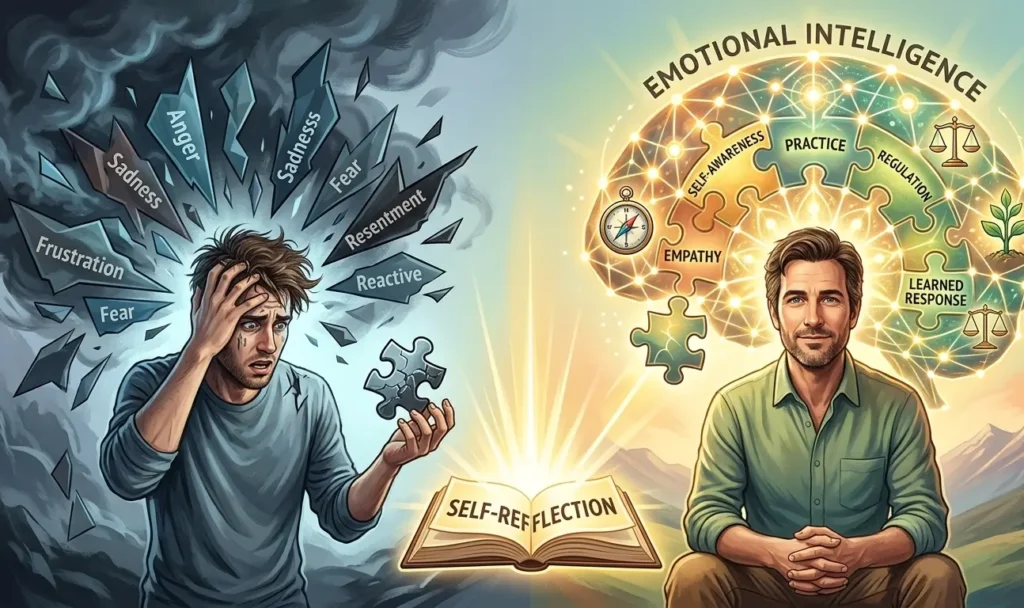
The Situation May Stay the Same, But You Can Change
There are situations in my life that existed before and still exist today.
The difference is me.
Earlier, I would react differently to certain situations. Today, I look at them from a completely different perspective. I don’t necessarily have fewer problems. I have simply learned to approach some of them differently.
One of the simplest examples is my relationship with my father.
There were many things about his personality that I used to argue about. I would try to convince him to change certain habits or ways of thinking, even though those things were simply part of who he was.
Today, I see it differently.
Instead of constantly trying to change him, I have learned to change my behaviour around him.
And surprisingly, that has made things better. Nothing magical happened to the situation. I changed my response to it.
That, to me, is emotional intelligence in real life.
Are Some People Naturally More Emotionally Intelligent?
I believe the answer is yes—but only partly.
Some people seem to have emotional intelligence naturally. They can stay calm during situations that would make someone else extremely reactive. They seem to understand emotions, people, and situations almost instinctively.
But practice matters too.
I can see this even within my own family.
We are three siblings, and I genuinely feel that all three of us represent different combinations of natural and practiced emotional intelligence.
My brother, for example, seems to have a naturally strong ability to respondappropriately in many emotional situations. That doesn’t mean he hasn’t faced difficult things. He has. But his natural way of processing emotions is different from mine.
My younger sister is similar in many situations.
And then there is me. I know that a lot of my emotional intelligence has come through practice, experience, mistakes, reflection, and learning. And honestly, I am still practicing.
So perhaps emotional intelligence can be both:
A natural strength and a learned skill.
How much comes naturally and how much develops through experience may simply depend on the person.
Emotional Intelligence Requires Practice
Knowing what you should do and actually doing it are two completely different things.
You may know that you shouldn’t react immediately.
You may know that arguing won’t solve the problem.
You may know that taking everything personallywill only exhaust you.
You may even know that you should pause before responding.
But knowing isn’t always enough.

You have to practice.
And sometimes, you have to practice the same lesson again and again.
Maybe you won’t get it right the first time.
Or the second.
Or even the third. That doesn’t mean you can’t learn it.
It simply means the old habit is stronger right now.
If your habit of instantly reacting has become stubborn, your new habit of pausing, understanding, and responding needs to become even more stubborn.
That is how emotional intelligence develops.
You Don’t Have to Get It Right Immediately
I learned something similar while learning to drive.
My brother taught me how to drive a Maruti car, and at the same time, two of his friends were also learning.
For them, balancing the clutch and accelerator seemed relatively easy.
For me?
It was frustrating.
I struggled with the clutch and accelerator balance and would get irritated and tell my brother, “Mujhse nahi hoga.”
One of his friends would then start giving me a lecture about how I couldn’t learn if I stopped trying.
And honestly, instead of motivating me, it made me angry.
At that point, I decided I wasn’t going to learn at all.
Years later, I did learn to drive. And I learned from my brother.
Not because his friend’s lecture suddenly changed my heart.
I learned because I wanted to learn it for myself.
I realised that I have one life, and I didn’t want to remain dependent on someone else for something I could eventually learn myself.
That experience taught me something much bigger than driving.
Sometimes, the problem isn’t that you can’t learn something.
You simply haven’t found your own reason to keep trying yet.
Your Motivation Can Change Everything

If you genuinely want to become emotionally intelligent, find your reason.
Maybe you want healthier relationships.
Maybe you don’t want every small comment to ruin your entire day.
Maybe you’re tired of regretting things you say when you’re angry.
Maybe you want more peace.
Maybe you simply want to become a better version of yourself.
Whatever your reason is, hold on to it.
Because motivation can help you keep practicing when the change feels difficult.
And remember: one failed attempt is not proof that you cannot change.
It is simply one attempt.
How Do You Know Your Emotional Intelligence Is Improving?
You may not suddenly wake up one morning and think, “Congratulations, I am emotionally intelligent now.”
The change is usually much quieter.
You start noticing that you don’t feel the need to answer every argument.
You pause before sending that angry message.
You stop trying to change people who are determined to remain themselves.
You understand that someone’s behaviour doesn’t always require your reaction.
You begin listening instead of immediately defending yourself.
You can feel angry without allowing anger to decide your next action.
And perhaps the biggest sign is this: Things that once occupied your mind for hours suddenly don’t feel worth carrying anymore.
The situation may still happen.
But it doesn’t control you in the same way.
That’s growth.
Emotional Intelligence Doesn’t Mean Becoming Emotionless
Sometimes people misunderstand emotional intelligence.
Being emotionally intelligent doesn’t mean becoming cold, detached, or unaffected by everything.
It doesn’t mean saying, “I don’t care,” when you actually do.
It doesn’t mean suppressing your emotions.
You can be hurt and still respond calmly.
You can be angry and still choose your words.
You can disagree with someone without trying to destroy the relationship.
You can care deeply without allowing every emotion to control your behaviour.
Emotional intelligence isn’t about feeling less. It’s about understanding what you feel and choosing what you do with it.
You Can Learn If You Are Willing to Keep Learning
If you try something once and fail, don’t turn that failure into your identity.
Don’t say:
“This is just how I am.”
Maybe it is how you are right now.
But that doesn’t necessarily mean it is who you have to remain.
Life itself keeps teaching us.
Some lessons come gently.
Some come through heartbreak.
Some through relationships.
Some through rejection.
Some through mistakes we wish we could undo.
And some lessons take years to understand. But if you remain willing to learn, you can keep changing.
That is why I believe emotional intelligence can be learned.
Maybe some people are naturally better at it.
Maybe some of us need more practice.
Maybe some lessons take longer for us than they do for others.
But difficult doesn’t mean impossible.

Improve it. Love it. Live it.
The LUS Takeaway
You get one life.
Why spend all of it carrying unnecessary anger, frustration, sadness, emptiness, and emotional exhaustion?
Yes, life is difficult sometimes.
Yes, some problems don’t have instant solutions.
And yes, there will always be people and situations that test you.
But you don’t have to make your life heavier than it already is.
Learn.
Improve.
Practice.
Let go of what doesn’t deserve your energy. And when you don’t get it right today, try again tomorrow.
Because maybe the goal isn’t to become a perfectly emotionally intelligent person.
Maybe the goal is simply to become a little wiser, calmer, and kinder in the way you handle life than you were yesterday.
You have one life.
Improve it. Love it. Live it.