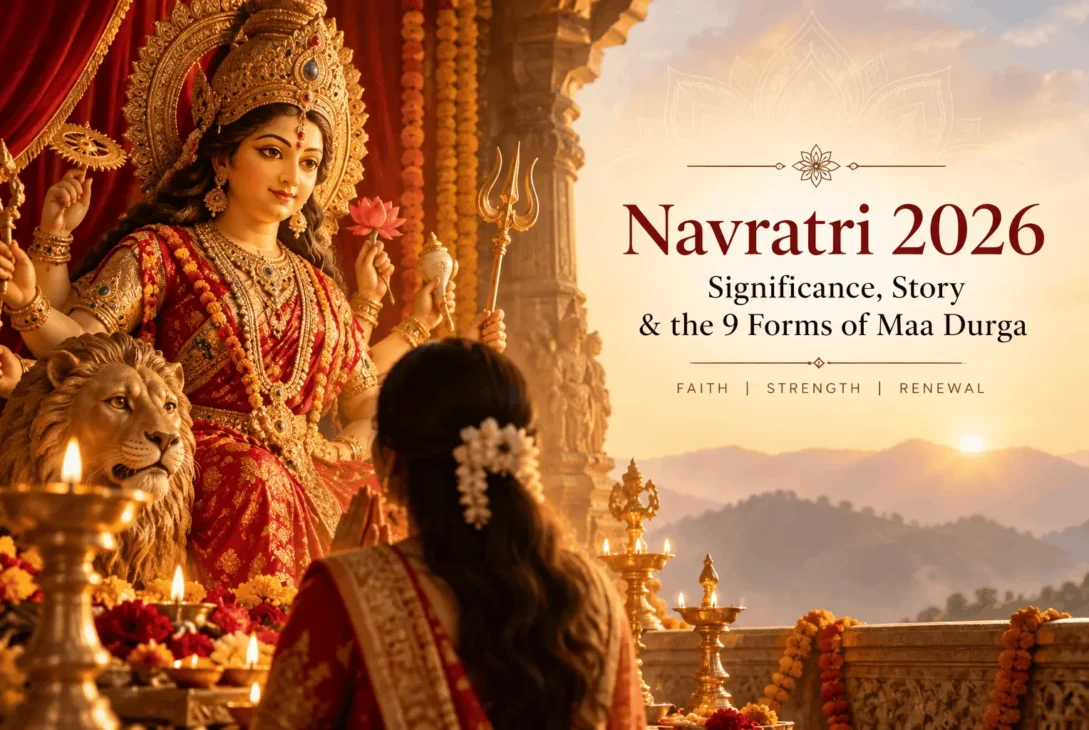
Navratri 2026 Dates and Important Details
Sharad Navratri is one of the most sacred festivals dedicated to Maa Durga and the divine power of Shakti. Celebrated over nine nights, this auspicious period honours the nine forms of the Goddess and reminds devotees of the enduring power of faith, courage and the victory of good over evil.
Navratri 2026 begins on Sunday, 11 October, and the nine-day observance continues through Monday, 19 October. Vijayadashami, also known as Dussehra, follows on Tuesday, 20 October, according to the commonly followed North Indian calendar.
When Is Sharad Navratri 2026?
Here are the important dates for Navratri 2026:
- Ghatasthapana: Sunday, 11 October 2026
- First day of Navratri: Sunday, 11 October 2026
- Last day of the nine-day observance: Monday, 19 October 2026
- Vijayadashami (Dussehra): Tuesday, 20 October 2026
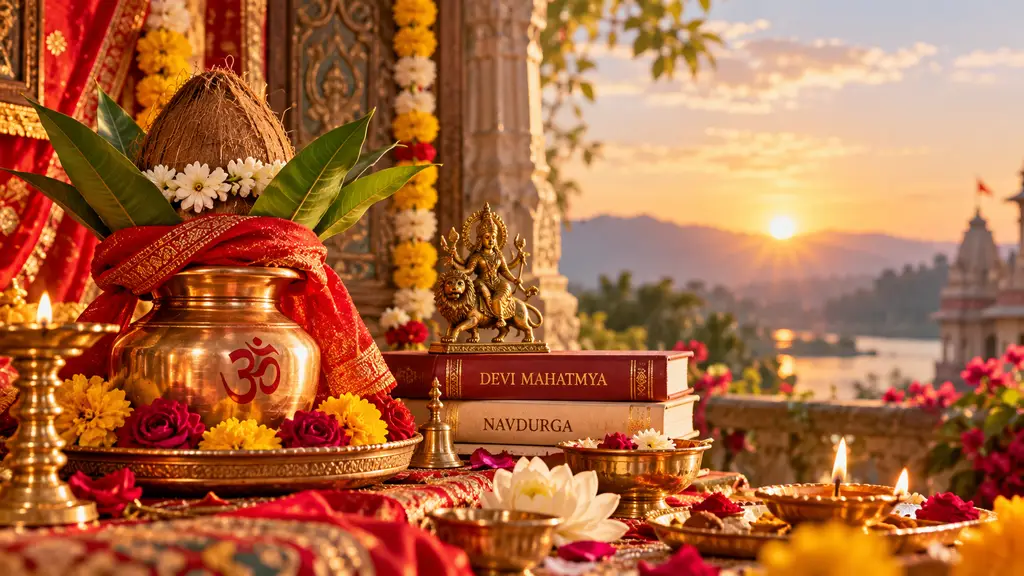
Ghatasthapana, also called Kalash Sthapana, marks the beginning of Navratri worship in traditions that observe this ritual. It involves establishing a sacred kalash as part of the invocation of the Goddess.
The exact Ghatasthapana muhurat depends on the local Panchang and location. Devotees should check timings for their own city rather than relying on a time calculated for another place.
Why Is Navratri Celebrated for Nine Nights?
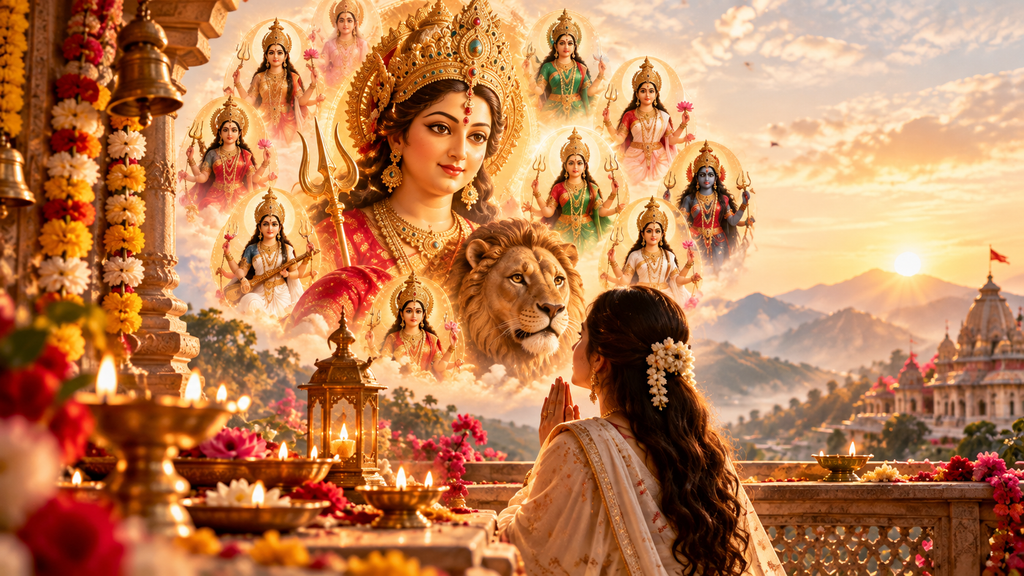
The word Navratri comes from two Sanskrit words: nava, meaning nine, and ratri, meaning night. During Sharad Navratri, devotees worship the nine forms of Maa Durga, collectively known as Navdurga.
Each form carries its own traditional significance, symbolism and stories. Together, they offer a rich understanding of Shakti—the divine feminine power celebrated throughout the festival.
For many devotees, Navratri is a time for prayer, fasting, reflection and renewal. Families and communities mark the occasion in different ways, from daily puja and devotional singing to Garba, Dandiya and Durga Puja. Although customs vary across regions, devotion to the Goddess remains at the heart of the celebration.
The festival culminates in Vijayadashami, which is widely associated with the triumph of good over evil. The way this day is observed differs across India’s religious and cultural traditions.
As we explore Navratri 2026, we will look beyond its dates and rituals to understand the story of Maa Durga, the significance of her nine forms and the deeper meaning of Shakti in our lives.Each form carries its own traditional significance, symbolism and stories. Together, they offer a rich understanding of Shakti—the divine feminine power celebrated throughout the festival.
For many devotees, Navratri is a time for prayer, fasting, reflection and renewal. Families and communities mark the occasion in different ways, from daily puja and devotional singing to Garba, Dandiya and Durga Puja. Although customs vary across regions, devotion to the Goddess remains at the heart of the celebration.
The festival culminates in Vijayadashami, which is widely associated with the triumph of good over evil. The way this day is observed differs across India’s religious and cultural traditions.
As we explore Navratri 2026, we will look beyond its dates and rituals to understand the story of Maa Durga, the significance of her nine forms and the deeper meaning of Shakti in our lives.
The Story Behind Navratri: How Maa Durga Defeated Mahishasura
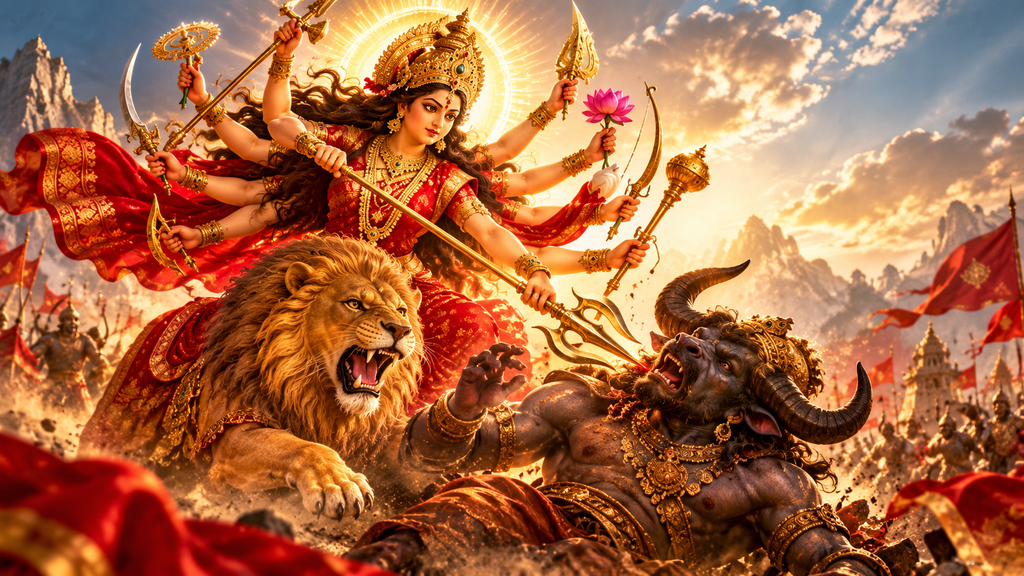
Among the many sacred stories associated with Navratri, the legend of Maa Durga and Mahishasura holds a special place. It is a story of divine power, the struggle against oppression, and the restoration of balance when arrogance threatens the world.
The story is told in the Devi Mahatmya, a revered Hindu text forming part of the Markandeya Purana. Also known as the Durga Saptashati or Chandi Path, this text celebrates the power and victories of the Divine Goddess.
The Rise of Mahishasura
According to the traditional legend, Mahishasura was a powerful asura who had received a boon from Lord Brahma. In popular tellings, he could not be defeated by a man or a male deity, a condition that filled him with immense confidence in his own invincibility.
Believing himself beyond defeat, Mahishasura grew increasingly powerful. He challenged the devas, defeated their forces and seized control of heaven, driving the gods from their rightful place.
The devas found themselves unable to overcome his growing might. Their efforts failed, and the balance of the three worlds was threatened by Mahishasura’s rule.
Realising that ordinary force could not resolve the crisis, the gods sought the help of the divine powers. Their combined radiance came together in a brilliant manifestation of Shakti, the supreme feminine power.
From this divine radiance emerged Maa Durga.
The Divine Appearance of Maa Durga
Maa Durga appeared with extraordinary splendour and strength. The gods offered her their divine weapons, each contributing to the power with which she would confront Mahishasura. Among these sacred weapons were Lord Shiva’s trident and Lord Vishnu’s discus. She rode a lion, symbolising her formidable presence as she prepared to face the asura.
Her appearance was not merely the arrival of another warrior. Within the story, she represented a divine power capable of confronting a force that had defeated the gods themselves.
Maa Durga accepted the challenge and went to battle against Mahishasura and his army.
The Battle Between Maa Durga and Mahishasura
A fierce battle followed. Mahishasura’s forces fought against the Goddess, but her strength proved beyond their expectations. When Mahishasura himself entered the battle, he used his ability to change forms to challenge her.
He appeared in different shapes, including that of a mighty buffalo, attempting to escape defeat and overpower the Goddess. Yet Maa Durga remained unwavering.
In the climactic encounter, she overcame Mahishasura and ended his reign. The devas rejoiced, and the cosmic order was restored. In Hindu devotional tradition, Maa Durga is therefore revered as Mahishasuramardini—the slayer of Mahishasura.
Her victory is remembered as a powerful expression of divine Shakti triumphing over a force that had become destructive through arrogance and the misuse of power.
Why Is This Story Associated With Navratri?
The victory of Maa Durga over Mahishasura is one of the central stories associated with Sharad Navratri and Durga Puja. The nine-night festival honours the Goddess, while Vijayadashami, the tenth day, is widely associated with the triumph of good over evil.
The ways in which this victory is commemorated differ across regions and traditions. In many communities, devotees worship Maa Durga through prayers, rituals and devotional gatherings, celebrating the Goddess’s power and seeking her blessings.
The story also gives the festival a meaning that extends beyond the battle itself. It presents a vision of divine power responding when disorder threatens the world and balance must be restored.
For devotees, Maa Durga’s victory remains a reminder of the strength and protection associated with the Divine Mother. Her story has continued to inspire generations through sacred texts, devotional songs, temple art and the traditions of Navratri.
As we turn towards the nine forms of Maa Durga, we encounter another dimension of this celebration: the many expressions of Shakti honoured during the nine sacred nights.
The Nine Forms of Maa Durga: The Story and Significance of Navdurga
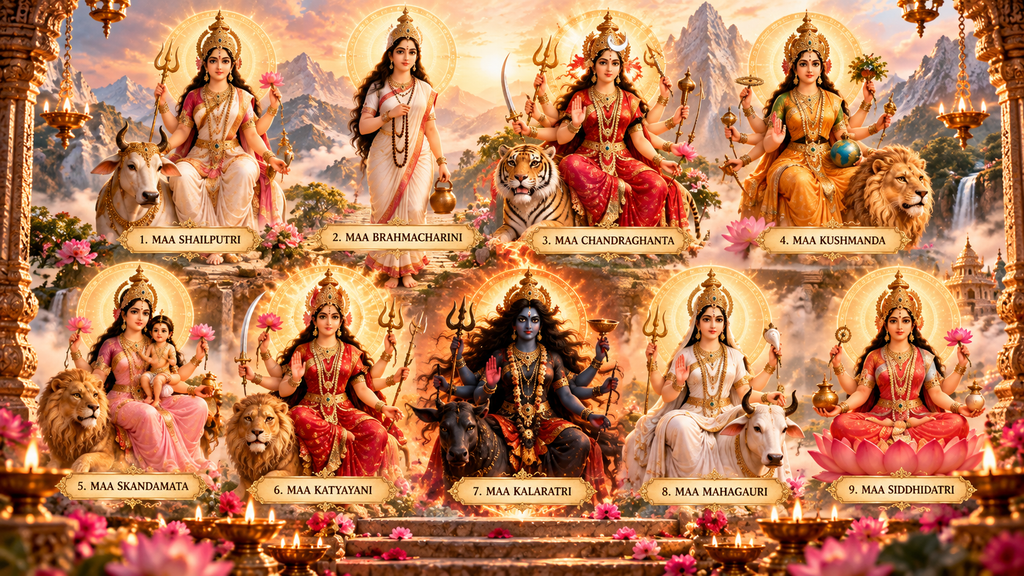
During Navratri, devotees worship nine forms of Maa Durga, collectively known as Navdurga. Each form has a distinct identity, appearance and spiritual significance. Together, they represent the many expressions of Shakti—from the power to begin a journey to the courage to overcome challenges and the wisdom to find peace within.
The nine forms are traditionally worshipped across the nine days of Navratri. Their stories and symbolism offer devotees different ways to reflect on faith, courage, discipline, compassion and spiritual growth.
1. Maa Shailputri — The Daughter of the Mountains
Maa Shailputri is worshipped on the first day of Navratri. Her name means “daughter of the mountains,” and she is associated with the Himalayas. In Hindu tradition, she is regarded as a form of Goddess Parvati and the daughter of King Himavan.
Often depicted riding a bull and holding a trident and lotus, Maa Shailputri represents strength, stability and a grounded beginning. Her form reminds devotees that every meaningful journey starts with a firm foundation, faith and the willingness to take the first step.
2. Maa Brahmacharini — The Goddess of Devotion and Penance
Maa Brahmacharini is worshipped on the second day. Her form is associated with devotion, penance and determination. According to Hindu tradition, Goddess Parvati undertook intense penance to attain Lord Shiva as her consort.
She is commonly depicted walking barefoot, holding a japamala and a kamandalu. Her story symbolises patience, self-discipline and dedication to a meaningful purpose. Maa Brahmacharini reminds devotees that some goals require perseverance, and that inner strength often develops through commitment and restraint.
3. Maa Chandraghanta — The Goddess of Courage
Maa Chandraghanta is worshipped on the third day of Navratri. Her name comes from the crescent moon shaped like a bell that adorns her forehead. She is often depicted riding a tiger or lion, with multiple arms carrying divine weapons and other sacred objects.
Her peaceful yet powerful presence represents courage, alertness and readiness to confront injustice. Maa Chandraghanta teaches devotees that gentleness and strength can exist together. Peace does not mean being powerless; it can also mean having the courage to stand up when necessary.
4. Maa Kushmanda — The Creator of the Universe
Maa Kushmanda is worshipped on the fourth day. According to a traditional belief, her divine smile brought light and energy into the universe when darkness prevailed. Her name is associated in popular explanations with the cosmic egg and the creation of the universe.
She is commonly portrayed with multiple arms holding divine objects and a rosary, and is associated with a lion. Maa Kushmanda symbolises creative energy, vitality and the power of a new beginning. Her story invites devotees to recognise the light that can emerge even when circumstances seem dark.
5. Maa Skandamata — The Mother of Skanda
Maa Skandamata is worshipped on the fifth day. She is the mother of Lord Skanda, also known as Kartikeya, the deity associated with divine warfare. She is often depicted seated on a lotus, holding her child Skanda, with a lion as her mount in many traditional representations.
Her form celebrates motherhood, care, courage and protection. Maa Skandamata reminds devotees that nurturing others is an expression of strength. Love can offer comfort, but it can also give someone the courage to face difficult circumstances.
6. Maa Katyayani — The Goddess of Courage and Justice
Maa Katyayani is worshipped on the sixth day of Navratri. In Hindu tradition, she is associated with the sage Katyayana and is revered as a powerful form of the Goddess. She is also connected with the tradition of the Goddess confronting destructive forces.
Often depicted riding a lion and carrying divine weapons, Maa Katyayani represents courage, determination and the strength to challenge injustice. Her form reminds devotees that standing up for what is right may require difficult choices and unwavering conviction.
7. Maa Kalaratri — The Goddess Who Removes Fear
Maa Kalaratri is worshipped on the seventh day. She is among the most fierce forms of Navdurga and is traditionally depicted with a dark complexion, dishevelled hair and a powerful, protective presence. Despite her formidable appearance, she is revered as a benevolent protector who helps devotees confront fear and darkness.
Maa Kalaratri symbolises the courage to face what frightens us rather than allowing fear to control our lives. Her story reminds devotees that transformation can be challenging, and that confronting darkness is sometimes necessary to move towards the light.
8. Maa Mahagauri — The Goddess of Purity and Peace
Maa Mahagauri is worshipped on the eighth day. Her name means “the exceptionally radiant one,” and she is commonly portrayed in white garments, riding a bull and holding a trident and damaru.
Traditional accounts associate her with purity, serenity and spiritual renewal. Maa Mahagauri represents the peace that follows hardship and the possibility of beginning again with a clearer heart and mind. Her form encourages devotees to cultivate compassion, simplicity and inner calm.
9. Maa Siddhidatri — The Goddess Who Grants Spiritual Accomplishment
Maa Siddhidatri is worshipped on the ninth day of Navratri. Her name is associated with the granting of siddhis, or spiritual accomplishments and extraordinary attainments, in Hindu tradition. She is often depicted seated on a lotus or riding a lion, holding sacred objects in her four hands.
Maa Siddhidatri represents wisdom, fulfilment and spiritual understanding. Her form brings the Navdurga journey to a close by reminding devotees that spiritual growth is not merely about seeking blessings or achievements; it is also about developing humility, balance and a deeper understanding of life.
The Deeper Significance of the Nine Forms
The nine forms of Maa Durga are traditionally honoured individually, yet they belong to one larger celebration of Shakti. Each form expresses a different quality—stability, devotion, courage, creativity, nurturing love, justice, fearlessness, peace and spiritual wisdom.
For many devotees, the journey through Navdurga becomes an opportunity for reflection. It encourages us to consider where we need greater patience, when we must act courageously, how we care for others and whether we are making room for peace and wisdom in our lives.
The significance of Navratri, therefore, extends beyond learning the names of the nine Goddesses. It also lies in understanding the values their stories inspire and finding thoughtful ways to carry those values into everyday life.
As we explore what each form of Maa Durga can teach us, we begin to see how the spiritual meaning of Navratri can connect with the challenges, choices and transformations of our own lives.
What Each Form of Maa Durga Teaches Us About Life
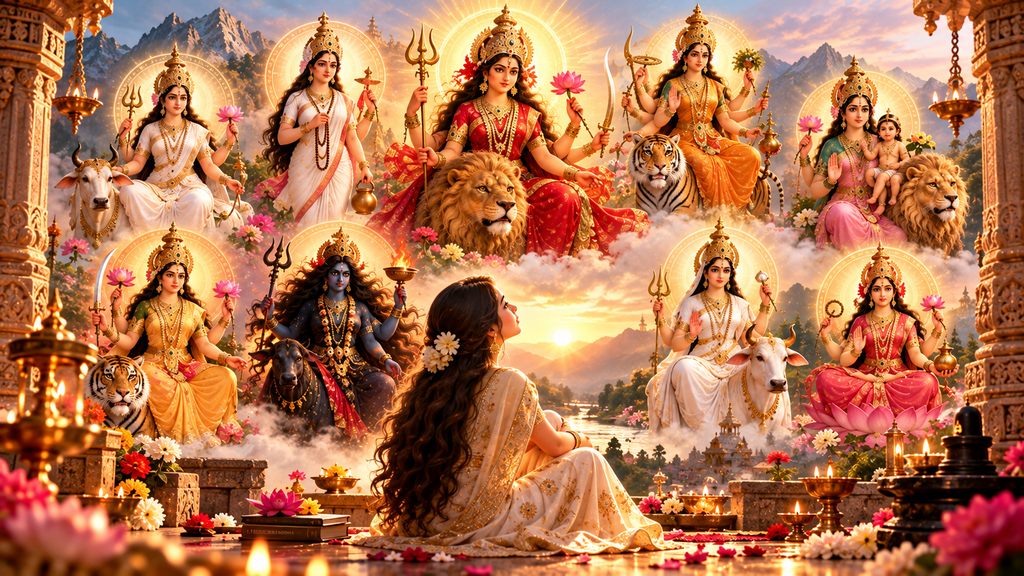
The nine forms of Maa Durga are not only worshipped during Navratri; their stories also offer meaningful lessons about how we live, grow and respond to life’s challenges. Each form represents a different expression of Shakti, reminding us that strength can appear as patience, courage, compassion, determination or the wisdom to remain peaceful when life becomes uncertain.
For me, the deeper beauty of Navdurga lies in understanding that these qualities do not exist in isolation. Life asks us to develop different kinds of strength at different times. Sometimes we need the courage to begin, sometimes the patience to continue, and sometimes the wisdom to recognise when we need to change.
1. Maa Shailputri: Have the Courage to Begin
Every journey begins with a first step, even when we cannot see the entire path ahead. Maa Shailputri represents the strength of a firm foundation and reminds us that beginnings matter. We often underestimate ourselves before even trying something new. We convince ourselves that a task is too difficult, that we are not capable enough or that we should wait until we feel completely ready. But confidence does not always arrive before action. Sometimes, it develops because we choose to take that first step.
Maa Shailputri inspires us to stay grounded in our values, trust our ability to learn and begin with faith, even when the future is uncertain.
2. Maa Brahmacharini: Let Patience Strengthen Your Purpose
Maa Brahmacharini symbolises devotion, discipline and perseverance. Her story reminds us that meaningful journeys often require patience, especially when progress is slow and the destination seems far away.
In everyday life, we can become discouraged when our efforts do not produce immediate results. We may question our decisions, compare our progress with others or feel tempted to give up. Yet growth often happens quietly, through the small choices we continue making even when nobody notices. Her form encourages us to remain committed to what truly matters, while remembering that patience does not mean accepting everything without thought. It means giving worthwhile efforts the time, discipline and consistency they need.
3. Maa Chandraghanta: Be Gentle, but Never Afraid to Stand Strong
Maa Chandraghanta represents courage and readiness to confront challenges. Her powerful form reminds us that gentleness and strength are not opposites. There are moments when keeping the peace is the wisest choice. At other times, silence can allow unfairness to continue. Learning to recognise the difference is an important part of emotional maturity.
We do not need to become harsh to protect our dignity, nor do we need to prove our strength to everyone around us. We can speak calmly, establish boundaries and stand by what is right without losing our sense of compassion. Maa Chandraghanta teaches us that true courage is not about creating conflict. It is about being prepared to face it when necessary.
4. Maa Kushmanda: Remember the Light You Carry Within
Maa Kushmanda is traditionally associated with the creation of the universe and the light that brings existence to life. Her symbolism offers a beautiful reminder that even a small beginning can open the way to something meaningful. There are phases in life when everything feels uncertain. We may lose motivation, question our abilities or struggle to imagine a brighter future. During such times, it is easy to believe that we have nothing left to offer.
But light does not always arrive as a dramatic transformation. Sometimes, it begins with one decision, one new habit, one honest conversation or one attempt to begin again. Maa Kushmanda inspires us to nurture the possibilities within us rather than allowing difficult circumstances to define everything we can become.
5. Maa Skandamata: Recognise the Strength in Caring for Others
Maa Skandamata represents motherhood, nurturing love and protection. Her form reminds us that caring for others can be an expression of strength, not a sign of weakness. Love often asks us to be present during difficult moments, to offer support without expecting recognition and to remain patient when someone we care about needs us. These responsibilities can be demanding, but they can also reveal qualities within us that we had not fully recognised before.
At the same time, caring for others should not require us to abandon ourselves. Compassion is most meaningful when it allows room for both the needs of others and our own well-being. Her story encourages us to value the quiet strength involved in nurturing, protecting and standing beside the people we love.
6. Maa Katyayani: Find the Courage to Stand Up for What Is Right
Maa Katyayani is associated with courage, determination and the power to confront destructive forces. Her form reminds us that some situations require more than patience; they require action. There may be times when we must speak up, make a difficult decision or step away from circumstances that repeatedly harm our peace. Doing so can feel uncomfortable, especially when we fear disappointing others or being misunderstood.
But choosing what is right does not always mean choosing what is easy. Courage involves recognising our responsibilities, respecting the dignity of others and acting with conviction when something needs to change. Maa Katyayani inspires us to use our strength purposefully—not to dominate others, but to protect what is valuable and stand firmly by our principles.
7. Maa Kalaratri: Face the Darkness You Cannot Avoid
Maa Kalaratri is one of the most powerful forms of Navdurga. Although her appearance is fierce, she is revered as a protective Goddess who helps devotees confront fear and destructive forces. Her symbolism reminds us that personal growth is not always comfortable. Sometimes, we must face painful truths, accept unexpected changes or acknowledge feelings we have spent a long time avoiding.
I believe that becoming stronger does not mean never feeling afraid, hurt or uncertain. It means learning not to let those feelings make every decision for us. We can acknowledge our pain without allowing it to define our entire identity. Maa Kalaratri teaches us that facing darkness is not the same as becoming darkness. Sometimes, it is the beginning of understanding ourselves more deeply and finding the courage to move forward.
8. Maa Mahagauri: Choose Peace Without Losing Your Strength
Maa Mahagauri represents purity, serenity and spiritual renewal. Her form reminds us of the value of peace, especially after periods of difficulty and change. In a world where people often feel pressured to react immediately, prove themselves or have the last word, choosing calmness can require considerable strength. Not every disagreement needs to become an argument, and not every misunderstanding deserves our energy.
But peace should not be confused with suppressing our feelings or tolerating repeated disrespect. We can remain kind while setting boundaries. We can disagree without humiliating someone. We can walk away from unnecessary conflict without feeling that we have lost. Maa Mahagauri inspires us to protect our inner calm while remaining honest, respectful and true to our values.
9. Maa Siddhidatri: Let Wisdom Complete Your Journey
Maa Siddhidatri, worshipped on the ninth day of Navratri, represents spiritual accomplishment and divine wisdom. Her place at the end of the traditional Navdurga sequence offers a meaningful reminder that growth is not only about what we achieve, but also about what we understand along the way.With experience, we may begin to recognise that success without humility can leave us dissatisfied, while knowledge without compassion can distance us from others. Wisdom helps us understand when to act, when to listen, when to persevere and when to let go.
The journey through the nine forms also reminds us that no single quality is enough for every situation. Courage needs wisdom, strength needs compassion, and determination needs patience.For me, this is one of the most beautiful ways to understand Navdurga: each form has its own significance, yet together they reflect a larger, interconnected journey. Just as the different parts of a body have distinct roles, each stage of a journey contributes to the whole. This is my personal spiritual interpretation of the nine forms—not a claim that every devotee must understand them in the same way.
What the Nine Forms of Maa Durga Teach Us About Inner Strength
My understanding of Shakti has become more personal through the experiences life has brought me. When my brother moved abroad, I discovered that I was capable of handling things I had once thought were beyond me. He had taught me how to drive, yet there was a time when I genuinely believed I would never be able to do it. Eventually, I learned. When my father had an accident last year, I also had to take on household and outside responsibilities while navigating the difficulties that came with that period. It was not that I suddenly became fearless or that every challenge became easy. Rather, I began to recognise a strength within myself that I had not known how to access before. These experiences changed how I think about inner strength. Sometimes, we discover our capabilities only when life places us in situations we never expected to face. We may begin with uncertainty, learn through experience and gradually become more confident in our ability to handle what comes next.
This is one reason the nine forms of Maa Durga resonate with me. I see their stories as an invitation to reflect on the many qualities life asks us to develop. We may need the determination of Maa Brahmacharini in one season of life, the courage associated with Maa Katyayani in another, and the calmness symbolised by Maa Mahagauri when we need to protect our peace. We do not have to embody every quality perfectly. We are human, and growth takes time. What matters is our willingness to learn, to act with awareness and to become more thoughtful in how we respond to the world around us.
For me, Navratri is a reminder that Shakti is not only something we worship with devotion; it is also something we can reflect upon through our choices, responsibilities and actions. The nine forms of Maa Durga invite us to recognise different expressions of strength and to consider how we might bring more courage, compassion, discipline and wisdom into our everyday lives.And perhaps that is where the deeper journey begins: not simply in knowing the names of the nine Goddesses, but in reflecting on the qualities their stories inspire us to cultivate.
Navratri 2026 Colours and Their Significance
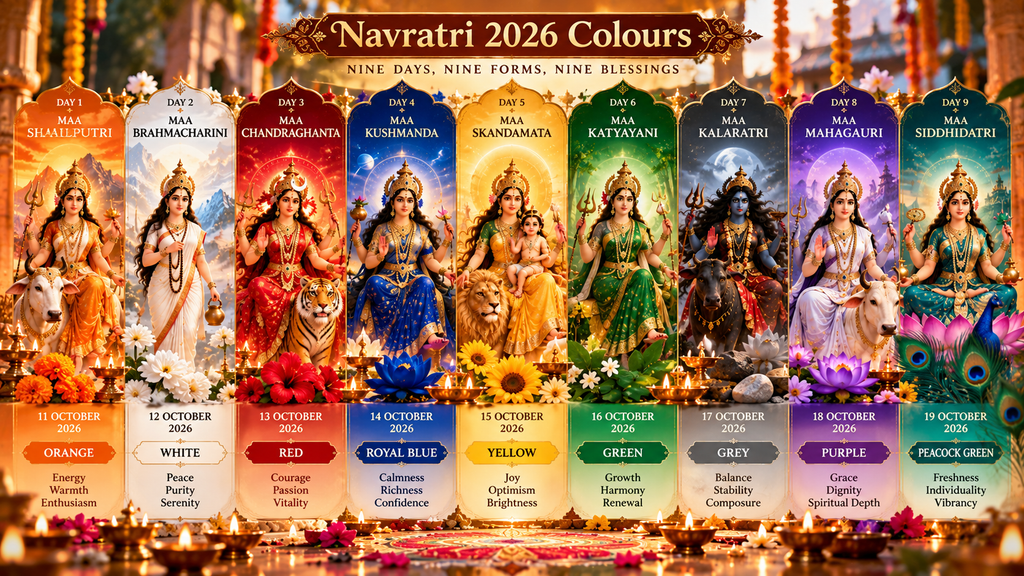
One of the beautiful traditions associated with Navratri is wearing a different colour on each of the nine days dedicated to Maa Durga. From vibrant orange and powerful red to peaceful white and graceful purple, these colours add joy, beauty and a sense of togetherness to the festive season.
During Sharad Navratri, many devotees choose their outfits according to the colour associated with each day. The tradition is especially popular in parts of western India, including Gujarat and Maharashtra. The colours are commonly linked with qualities such as energy, peace, devotion and renewal. However, wearing a particular colour is a cultural tradition rather than a compulsory religious rule, and practices may vary between families and regions.
What Are the Nine Colours of Navratri 2026?
According to the commonly followed Navratri colour sequence published by Drik Panchang, the colours for Sharad Navratri 2026 are as follows.
| Date | Day of Navratri | Colour | Traditional association |
|---|---|---|---|
| 11 October 2026 | Day 1 — Maa Shailputri | Orange | Energy, warmth and enthusiasm |
| 12 October 2026 | Day 2 — Maa Brahmacharini | White | Peace, purity and serenity |
| 13 October 2026 | Day 3 — Maa Chandraghanta | Red | Courage, passion and vitality |
| 14 October 2026 | Day 4 — Maa Kushmanda | Royal Blue | Calmness, richness and confidence |
| 15 October 2026 | Day 5 — Maa Skandamata | Yellow | Joy, optimism and brightness |
| 16 October 2026 | Day 6 — Maa Katyayani | Green | Growth, harmony and renewal |
| 17 October 2026 | Day 7 — Maa Kalaratri | Grey | Balance, stability and composure |
| 18 October 2026 | Day 8 — Maa Mahagauri | Purple | Grace, dignity and spiritual depth |
| 19 October 2026 | Day 9 — Maa Siddhidatri | Peacock Green | Freshness, individuality and vibrancy |
Note: Colour associations are symbolic interpretations commonly used in Navratri traditions. They are not universal rules, and regional colour lists may differ.
What Do the Navratri Colours Symbolise?
Beyond festive clothing, colours can offer a simple way to reflect on the qualities we wish to nurture in our lives.
Orange — Energy and enthusiasm: Orange evokes warmth, optimism and the willingness to begin something new. It brings a vibrant spirit to the opening day of Navratri.
White — Peace and purity: White is associated with calmness, simplicity and clarity. It reminds us of the value of approaching life with a peaceful mind.
Red — Courage and vitality: Red represents passion, strength and energy. It is also widely associated with devotion to the Goddess.
Royal Blue — Confidence and tranquillity: This rich shade combines a sense of elegance with calmness. It can remind us to approach challenges with composure and confidence.
Yellow — Joy and positivity: Bright and cheerful, yellow is associated with optimism, warmth and happiness.
Green — Growth and renewal: Green reflects nature, harmony and new beginnings. It reminds us that growth often happens gradually, with patience and care.
Grey — Balance and stability: Grey represents steadiness and a balanced approach. It encourages us to remain grounded even when circumstances change.
Purple — Grace and dignity: Purple is traditionally associated with grandeur, dignity and spiritual depth. Its rich appearance adds a sense of elegance to the festival.
Peacock Green — Freshness and individuality: This distinctive blend of blue and green evokes freshness and uniqueness, celebrating the beauty of different expressions and perspectives.
Is It Necessary to Wear the Navratri Colour Every Day?
No. Wearing the colour of the day is a festive custom, not a requirement for worship. Devotees may follow it as a joyful expression of participation, while others may choose their clothing according to personal preference, family traditions or convenience.
The essence of Navratri is devotion to Maa Durga and the spiritual significance of the festival. A person’s faith cannot be measured by whether they own a particular outfit or wear a specific colour on a particular day.
You can participate in the tradition through a saree, kurta, dupatta, jewellery or even a small accessory in the day’s colour. There is no need to buy something new for every day. What matters is celebrating in a way that feels sincere, respectful and meaningful to you.
As we celebrate the nine colours of Navratri 2026, we can enjoy the beauty of the tradition while remembering that the festival’s deeper significance extends far beyond what we wear. The colours may change each day, but the values of faith, courage, compassion and devotion can remain with us long after the celebrations end.
How to Celebrate Navratri Spiritually: Beyond Rituals
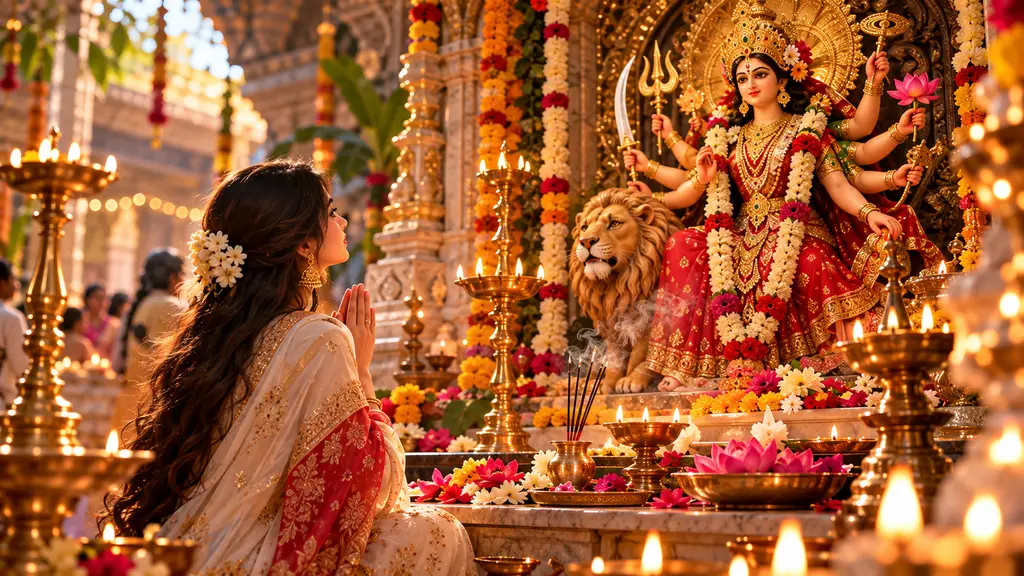
Navratri is a time of devotion, prayer and celebration. Homes are decorated, temples welcome devotees, and people come together to honour Maa Durga through rituals, fasting, devotional songs and other traditions. These practices hold deep meaning for many families and communities, carrying faith and cultural values from one generation to the next.
Yet, beyond the celebrations and rituals, Navratri also invites us to reflect on a more personal question: what does devotion truly mean to us?
For me, devotion begins with sincerity. It is not measured by how loudly we pray, how many offerings we make or how publicly we express our faith. It is reflected in the respect we show, the intentions we carry and the way we treat other people. Rituals can help us feel connected to the divine, but their deeper meaning becomes clearer when they are accompanied by humility, compassion and awareness.
1. Let Your Devotion Come From the Heart
Every person has a different way of connecting with God. Some find peace in visiting temples, others prefer meditation, prayer at home, devotional singing or simply sitting quietly with their thoughts. These differences do not have to divide us.
I believe that sincere devotion does not need to become a competition. We do not have to prove that our way of worship is better than someone else’s, nor should we make another person feel that God will be displeased because they follow a different practice.
Faith is deeply personal. What matters is the sincerity with which we approach it and the values it inspires within us. When devotion makes us more humble, compassionate and thoughtful, it becomes more than a ritual performed at a particular time of day.
2. Remember That Offerings Are Only One Part of Worship
Flowers, sweets, coconuts, incense and diyas are meaningful parts of many Hindu worship traditions. They can express gratitude, love and reverence for the Goddess. There is beauty in preparing an offering with care and participating in customs that hold significance for our families.
At the same time, I feel that the spirit behind an offering matters deeply. A beautiful arrangement of flowers cannot replace kindness, just as an elaborate ritual cannot automatically make us more patient or understanding.
For me, the essence of bhakti lies in the sincerity with which we remember the divine. It also lies in whether we carry that devotion into our everyday behaviour—whether we speak respectfully, act honestly and show consideration to those around us.
This is not about dismissing rituals. It is about remembering why they matter and allowing them to deepen our connection with the values we worship.
3. Make Room for Others to Pray in Peace
Religious spaces often bring together people of different ages, backgrounds and temperaments. During festivals such as Navratri and Sawan, temples can become especially crowded as devotees gather to offer prayers and seek blessings.
I remember visiting a crowded Mahadev temple during Sawan when people were pushing against one another in their eagerness to reach the place of worship. The situation became uncomfortable, and there was a risk of people stumbling or getting hurt.
That experience stayed with me because it raised an important question: while trying to reach the divine, are we remembering the people standing beside us?
A place of worship should offer an opportunity for prayer, not become a space where basic consideration disappears. Following queues, allowing others room to move, avoiding unnecessary pushing and respecting temple instructions are simple acts, but they matter.
We may arrive at a temple carrying different prayers, worries and hopes. A little patience and discipline can help everyone worship more peacefully. In my view, consideration for another devotee is not separate from devotion; it can be one of its most practical expressions.
4. Celebrate With Joy Without Forgetting Consideration
Festivals bring music, gatherings, devotional singing and a wonderful sense of community. For many people, these traditions are an important expression of faith and belonging. There is nothing wrong with celebrating joyfully or coming together to sing in praise of the Goddess.
However, celebration also comes with responsibility. Sound levels, timing, cleanliness and the needs of neighbours deserve consideration, especially when children are studying, older people are resting or someone is unwell.
The same applies to our conversations during religious gatherings. Instead of judging someone’s clothes, comparing offerings or turning devotion into gossip, we can use these occasions to build understanding and strengthen our relationships.
Of course, not every gathering is like this, and people celebrate in many thoughtful ways. The point is not to criticise celebration itself, but to remember that faith and consideration can exist together.
Maa Durga is revered as a source of strength and protection. Celebrating her can also inspire us to become more considerate of the people around us.
5. Practise the Values You Pray For
One of the most meaningful ways to honour Maa Durga is to reflect on the qualities associated with her different forms and consider how they might guide our actions.
If we pray for strength, can we use it without humiliating others? If we ask for peace, can we avoid creating unnecessary conflict? If we seek blessings, can we also become more generous, patient and understanding?
These questions are not about judging anyone’s devotion. They are reminders that spiritual growth is a personal journey, and each of us has room to learn.
We do not have to become perfect overnight. We can begin with small changes: listening before reacting, apologising when we are wrong, helping someone without expecting praise, or respecting a belief even when it differs from our own.
For me, these everyday choices are an important part of living the values that religious traditions encourage us to honour.
6. Respect Different Ways of Expressing Faith
India’s spiritual traditions are diverse. Even among people who worship the same Goddess, rituals, fasting practices, prayers and family customs may differ.
Some devotees observe strict fasts, while others participate through prayer or community celebrations. Some visit temples daily during Navratri, while others worship at home. These practices can carry different meanings for different people.
We should be careful not to assume that everyone must express faith in exactly the same way. A person’s devotion cannot be fairly judged by outward appearances alone, and no single individual can claim to know another person’s entire relationship with God.
Navratri offers an opportunity to celebrate this diversity with respect. We can remain devoted to our own traditions while allowing others the freedom to follow theirs, provided our actions remain considerate of those around us.
7. Carry the Spirit of Navratri Beyond Nine Days
When Navratri ends, the decorations may come down, the festive clothes may return to our wardrobes, and daily routines may resume. But the values we reflect on during these nine days do not have to end with the celebrations.
We can carry courage into difficult decisions, patience into our relationships, compassion into our conversations and humility into our achievements. We can remember Maa Durga not only during prayer, but also when choosing how to respond to someone who disagrees with us or when deciding whether to help another person.
For me, this is where the spiritual meaning of Navratri becomes especially powerful. Devotion does not need to be loud to be sincere, and it does not need an audience to be meaningful. Sometimes, it appears in the quietest choices we make when nobody is watching.
Navratri is a celebration of Maa Shakti, but it can also be an opportunity to reflect on the strength, awareness and kindness we wish to develop within ourselves.
Perhaps the most meaningful question to carry through the festival is not simply how beautifully we have celebrated, but what our devotion is inspiring us to change.
Because worship can begin with a prayer, but its values can continue through the way we live.
The Deeper Meaning of Navratri: Shakti, Balance and Inner Transformation
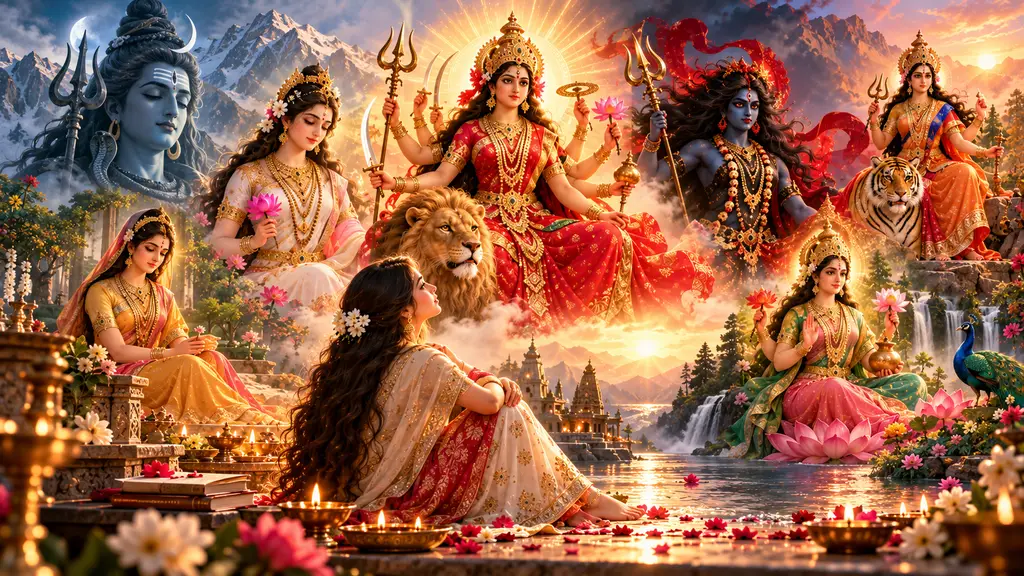
Navratri is often recognised through the beauty of its celebrations: the glow of diyas, the sound of devotional songs, the colours of traditional clothing and the worship of Maa Durga in her nine forms. Yet, beneath these familiar traditions lies a deeper spiritual idea—Shakti, the divine power that gives life its energy, movement and possibility.
For me, Shakti is not simply a word associated with strength or the feminine divine. It represents a profound power that I believe exists throughout creation. In my spiritual understanding, even the relationship between Shiv and Shakti reflects something essential: stillness and energy, consciousness and action, are not meaningful in isolation from one another. Shakti is not merely an ornament of divinity; she represents the power through which existence becomes dynamic.
This is why I find the deeper meaning of Navratri so fascinating. The stories of Maa Durga and her many forms are not only traditions to remember during a festival. They also invite us to reflect on strength, responsibility, balance and the ways we choose to live.
Shakti Is More Than Strength—It Is the Wisdom to Use It
We often admire strength when it is visible: when someone stands up for themselves, faces a difficult situation or refuses to surrender in the face of adversity. But strength has another side that is quieter and sometimes more difficult to practise.
It is the ability to remain calm when anger would be easier. It is knowing when to speak and when silence serves a greater purpose. It is having the power to hurt someone with our words, yet choosing to respond with dignity. It is also recognising when patience has reached its limit and a firm boundary is necessary.
For me, this is an important way to understand Shakti. Having power does not mean using it at every opportunity. It means understanding its consequences and choosing how to express it.
A person can be strong without being intimidating, confident without being arrogant and independent without disregarding the feelings of others. Strength becomes more meaningful when it is guided by awareness.
The nine forms of Maa Durga offer a rich spiritual lens through which to contemplate these different qualities. Their stories remind us that courage, gentleness, determination and peace can all have a place in a complete life. One quality does not need to destroy another for it to matter.
The Many Expressions of a Woman: Gentleness, Courage and Fierceness
One aspect of Shakti that resonates deeply with me is the idea that a woman does not have to express herself in only one way.
Society sometimes places women into narrow categories. A woman who is gentle may be expected to remain quiet in every situation. A woman who speaks firmly may be labelled difficult. A woman who chooses independence may be misunderstood, while a woman who prioritises her family may be judged for making a different choice.
But human nature is far more complex than these labels allow.
In Hindu tradition, the Goddess is worshipped through many expressions. Maa Parvati is associated with love and devotion; Maa Durga is revered for courage and protection; Maa Kali embodies fierce power against destructive forces. These forms are distinct, yet they belong to the wider spiritual understanding of the divine feminine.
For me, they offer a meaningful reminder that gentleness does not cancel courage, and courage does not require the absence of compassion.
A woman can be patient without accepting repeated disrespect. She can be kind without allowing others to take advantage of her. She can choose peace without surrendering her dignity. And when circumstances demand it, she can stand firmly against what is harmful or unjust.
I also find meaning in the contrasting examples of Maa Sita and Maa Kali. In my personal interpretation, Maa Sita represents dignity, endurance and the strength of remaining true to one’s values through hardship, while Maa Kali represents the fierce power needed to confront destructive forces. Their stories belong to different traditions and contexts, but together they encourage me to reflect on the many ways strength can appear.
A woman does not need to become harsh to prove that she is strong, nor must she remain silent to prove that she is good. There is room for tenderness and firmness, patience and action, humility and self-respect.
Shakti, to me, is the freedom to express the strength a situation requires without losing the values that define us.
True Empowerment Includes Supporting Other Women
If Shakti represents power, then one question worth asking is how we use our power in our relationships with one another.
Women and girls often face expectations that are already demanding enough. Yet, sometimes, we add to those pressures by comparing appearances, questioning one another’s choices or turning differences into unnecessary rivalry.
We may disagree about relationships, careers, clothing, family responsibilities or personal beliefs. We may choose entirely different paths and hold different opinions about what a fulfilling life should look like. None of these differences automatically makes one woman better or more deserving of respect than another.
For me, celebrating feminine strength also means learning to respect these differences. It means offering encouragement instead of constantly comparing ourselves, allowing other women to grow without feeling threatened and recognising that another person’s success does not diminish our own.
This does not mean agreeing with everyone or overlooking harmful behaviour. Healthy disagreement and honest criticism have their place. But there is a difference between expressing a genuine concern and deliberately humiliating someone.
The spirit of Shakti can inspire us to become more conscious of how we treat one another. Strength should help us stand on our own feet, but it can also help us make room for others to stand with confidence beside us.
When women support one another without demanding that everyone live the same way, strength becomes something that can be shared rather than something that must be competed for.
Kindness, Humility and Integrity Are Never Outdated
Modern conversations about empowerment often focus on independence, freedom and the right to make personal choices. These are important ideas, but I believe freedom becomes more meaningful when it exists alongside responsibility.
Being independent does not require us to become indifferent to others. Having an opinion does not give us permission to humiliate someone who disagrees. Choosing our own path does not mean that honesty, loyalty, kindness and respect have suddenly become unimportant.
For me, these values are not signs of weakness or outdated expectations. They are qualities that help us use our freedom thoughtfully.
We can question traditions without insulting people who cherish them. We can disagree with someone’s beliefs without treating them as inferior. We can establish boundaries while still communicating with decency. And we can recognise our own worth without needing to make another person feel smaller.
This balance matters because power without responsibility can become destructive, just as kindness without boundaries can leave us vulnerable to repeated mistreatment.
The deeper lesson, as I understand it, is not to choose between strength and goodness. It is to develop the wisdom to practise both.
Inner Transformation Begins With Honest Self-Reflection
Navratri is associated with the worship of Maa Durga, but it can also become a meaningful time to examine our own thoughts, habits and responses.
It is easy to identify negativity in the world around us. It is more challenging to recognise when our own anger becomes unnecessary harshness, when pride prevents us from apologising or when fear causes us to judge someone before understanding them.
Inner transformation does not mean blaming ourselves for every mistake. It means becoming willing to learn from our behaviour rather than defending it automatically.
We can ask ourselves a few simple questions during Navratri:
- Am I using my strength to protect what matters or merely to win an argument?
- Can I respect someone whose beliefs or choices differ from mine?
- Do I offer others the patience and understanding I hope to receive?
- Am I holding on to anger that I could begin to release?
- Are my actions reflecting the values I pray for?
These questions do not have to produce perfect answers. Their purpose is to encourage awareness.
For me, spiritual growth is not about appearing flawless. It is about becoming more honest with ourselves, recognising where we need to change and making a sincere effort to do better. Sometimes transformation begins with a major decision; at other times, it starts with a small change in how we speak, listen or respond.
The value of reflection lies in what we choose to do with what we discover.
Shakti Connects Us to a Larger Whole
One of the most meaningful aspects of Navratri for me is the relationship between the nine forms of Maa Durga. Each has a distinct identity and significance, yet the celebration brings them together within a larger understanding of Shakti.
I see a personal parallel in the way we live. A human being is not defined by one quality alone. We need courage, but we also need patience. We need independence, but we also need connection. We need compassion, but we must also learn to protect our dignity.
Life changes, and different circumstances call for different responses. A decision that requires courage today may require patience tomorrow. A moment that calls for speaking up may be followed by one that calls for listening carefully.
This is why I find balance so important. Balance does not mean remaining in the middle of every disagreement or avoiding difficult decisions. It means understanding the situation, recognising what matters and responding with the qualities most appropriate to that moment.
Through my own spiritual lens, Shakti represents this interconnectedness: a reminder that different expressions of power can belong to a greater whole. This is my personal interpretation of the symbolism of Navratri, offered with respect for the many ways devotees understand the Goddess.
Carry the Spirit of Shakti Into Everyday Life
As Navratri comes to an end, the celebrations eventually give way to ordinary routines. The diyas are put away, the decorations are removed and everyday responsibilities return. Yet the ideas we reflect on during the festival can continue to shape our lives.
We can carry the courage to begin again when something goes wrong. We can practise patience when progress takes longer than expected. We can choose compassion without abandoning boundaries, and we can protect our peace without deliberately disturbing someone else’s.
We can also remember that strength does not always need an audience. Sometimes, it is visible in the person who quietly handles a difficult responsibility, the woman who rebuilds her confidence after a setback, the individual who admits a mistake or the person who refuses to let disappointment turn into cruelty.
For me, the deeper meaning of Navratri lies in this possibility of reflection and renewal. Worshipping Maa Shakti can inspire us to look beyond appearances and consider what strength, balance and transformation mean in our own lives.
The Goddess may be honoured through many names, forms and traditions, but the values we take from those stories become personal through the choices we make.
Perhaps the most meaningful way to celebrate Shakti is to recognise that strength and kindness can coexist, freedom and responsibility can support one another, and inner transformation begins when we are willing to look honestly at ourselves.
Because Shakti is not only about discovering how powerful we can become. It is also about understanding what kind of power we choose to be.
Conclusion: The Shakti We Worship and the Values We Live
Navratri is a celebration of Maa Durga, the nine forms of the Goddess and the divine power of Shakti. Through its stories, rituals and traditions, the festival reminds devotees of courage, devotion, perseverance and the enduring triumph of good over evil.
But the meaning of Navratri can extend beyond nine nights of worship. It can invite us to reflect on the kind of strength we wish to develop, the values we choose to protect and the way we treat the people around us.
For me, the beauty of Shakti lies in its many expressions. Strength can be fierce when something must be confronted, gentle when someone needs compassion and quiet when patience is the wiser response. We can stand firmly by our values without losing kindness, respect different perspectives without abandoning our own beliefs, and seek peace without confusing it with weakness.
The nine forms of Maa Durga also remind me that no single quality defines a complete journey. Courage needs wisdom, determination needs patience, and strength becomes more meaningful when guided by compassion. This is my personal understanding of the spiritual message of Navratri: the qualities we admire in the Goddess can also inspire us to reflect on our own choices and actions.
As Navratri 2026 approaches, may this sacred festival bring devotion into our prayers, awareness into our thoughts and kindness into our everyday lives. May we celebrate Maa Shakti with sincerity, respect the different ways people express their faith, and remember that spiritual growth is not about appearing perfect—it is about remaining willing to learn and become better.
When the diyas are extinguished and the festive decorations are put away, the values we take from Navratri can continue to guide us. We can carry courage into uncertainty, compassion into our relationships and humility into our achievements.
Perhaps the deepest tribute to Shakti is not only to worship divine strength, but to learn how to live with strength, wisdom and kindness ourselves.
May Maa Durga bless everyone with courage in difficult times, peace in moments of uncertainty and the wisdom to recognise the light within.
Jai Mata Di! 🌺